A beginner’s guide to funds
Discover what they are, how to trade them and everything else you need to know in this simple guide.

Funds can be a great way to get started in investing. And whether you want a comfortable retirement, to afford a home or to grow your wealth over the long term, this guide will help you understand the benefits and complexities of funds and how to include them in your investment portfolio.
Please keep in mind that the following is not personal advice. If you’re unsure what’s right for you, consider getting financial advice.
What is a fund?
Funds offer a simple and convenient way to invest. They also make it easy to diversify across a number of different investments and give you access to the skills of a professional fund manager.
A fund pools together the money of lots of different investors, and a fund manager invests on their behalf. Funds can invest in various types of assets, such as shares, bonds or property, depending on the investment objective of the fund.
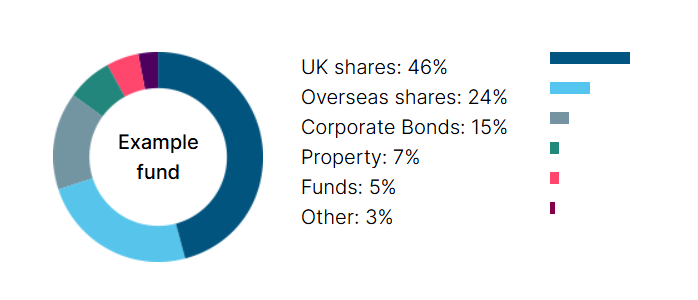
With a professional making the investment decisions, investing in funds takes away much of the pressure of choosing and managing your own individual assets. For many, this justifies the fee the fund manager charges – this could be around 75p a year for every £100 invested but each fund will have different charges.
If you invest with a fund manager who chooses assets that perform well, the value of your investments will increase over time. But it’s important to remember that investments can fall as well as rise in value so you could get back less than you invest.
While all investors seek to grow their wealth, there are a number of ways to achieve this goal. As such, many different types of funds exist too. Some invest globally across multiple assets, while others focus on specific assets, sectors or regions.
How to trade funds
Funds are split into units. Each unit represents a tiny share of the fund’s underlying investments. And when you invest in a fund, you receive a number of these units from the fund manager.
The fund manager creates the units when an investor buys into the fund. For many funds, there is no limit on the number of units that can be issued, or number of people who can invest. These funds are sometimes described as open-ended investments.
Every day, at a set valuation point (usually 12 noon) the fund manager calculates the value of the fund, giving a price per unit. This is based on the value of the fund's underlying investments.
Investors buy and sell units at that day's calculated price. Remember that because trade instructions need to be with the fund manager before the valuation point, investors must submit instructions to buy or sell units before the price is declared. So they will not know the price they will receive before the deal is placed.
What are the different types of funds?
While all funds have different strategies and aims, there are two main types: active funds and passive funds.
Active funds
As the name suggests, the manager actively chooses the underlying investments held in the fund on the investors’ behalf, aiming to outperform the market and their peers. Managers regularly research and adjust investments in an effort to outperform the market.
Passive funds (also known as index tracking funds)
These funds aim to match the performance of a particular stock market index – often by simply investing in every share in the index.
A key difference between active and passive fund management is the fees charged. Passive funds usually have lower ongoing charges because they require less day-to-day management. Active funds generally charge more due to the extra research and analysis involved, although a good fund manager can justify the added cost.
One way to view funds is via our Wealth Shortlist. This is a list of funds chosen by our analysts for their long-term performance potential.
View the Wealth Shortlist's actively managed funds
View the Wealth Shortlist's tracker funds
Income vs accumulation
Many funds give investors the choice between investing in either income or accumulation units. The difference is how the income generated by the investments in the fund is treated.
For example, if a fund is invested in shares, these shares will often pay dividends and thus generate an income. Income units pay dividends to investors as cash. Accumulation units reinvest them to buy more shares and increase the value of each unit.
Those who want to generate an income could consider choosing income units. Those looking for long-term growth in their investment will probably wish to choose accumulation units.
Investment trusts
Investment trusts are similar to funds as pooled investments. But they differ as they are traded on the stock market (rather than directly through the fund manager). As such, unlike funds which typically value once a day, they have a share price which moves up and down in value when the stock market is open.
While there are many good quality investment trusts available, investment trusts often involve more sophisticated techniques than regular funds, such as the manager borrowing money to try and boost returns. This can make them a higher risk investment.
View our guide to funds for more information on investment trusts
How do I choose a fund to invest in?
Different funds offer different levels of risk and potential rewards. Some fund managers adopt a cautious approach, trying to shelter investors from the worst of any stock market falls. Others are happy to take riskier investment strategies in search of potential higher returns.
Some managers look to add value by focusing on the bigger picture, identifying trends or reading the economic outlook before investing in areas they feel are most likely to benefit. Others place less importance on these wider influences and prefer to focus almost exclusively on the prospects for individual companies or investments.
With thousands of funds available, the choice can be daunting. That’s why we created the Wealth Shortlist to help narrow down the wide range on offer.
The Wealth Shortlist is for people who like to choose their own funds, and can help investors build well-balanced and diversified portfolios.
We continually monitor the list to make sure it only contains those funds our analysis indicates have the greatest performance potential.
Monthly investing vs lump sum
A lump sum is a one-off amount. Alternatively, you can invest ‘little and often’ with a monthly investing plan.
One of the reasons for the popularity of funds is that they give investors access to a wide range of investments, and offer the benefit of an expert manager, without the need to invest large sums of money.
With HL, you can invest as little as £100 into a fund as a lump sum, or set up a regular direct debit from just £25 per month.
Monthly investing has a number of benefits and can build wealth over time and reduce the impact of market fluctuations.
Please remember that investing involves risk and you could get back less than you invest.