Should I save or invest?
How to decide what to do with your money.
Important notes
This article isn’t personal advice. If you’re not sure whether an investment is right for you, please seek advice. If you choose to invest, the value of your investment will rise and fall, so you could get back less than you put in.
Saving vs investing: at a glance
Unsure whether to save or invest? Both can get you closer to your financial goals and can be used in different ways.
| Saving | Investing |
| Money you might need within five years | Usually for goals over five years |
| Lower chance of losing money | Higher risk with greater potential for growth |
| Easy access to your money | Better suited to saving for later life and building wealth over time |
| Good for emergency funds and short-term goals | Good for longer-term goals |
Saving is for the short term, while investing is for the longer term. In the short term, it’s typically a good idea to build up cash savings you can easily withdraw if you need to. Longer term, you might want to consider investing as a way of growing your money.
This article isn’t personal advice, so if you’re not sure what to do, please seek advice.
Saving – I need the money within 5 years
Although cash savings won’t fall in value, they’re not risk free. Cash often struggles to keep up with rising prices, or inflation, so you can lose money in real terms.
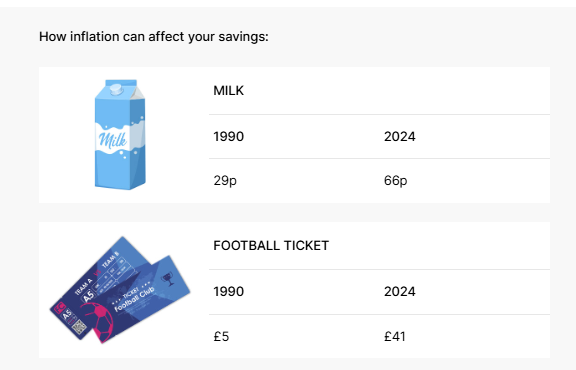
Source: Office of National Statistics and Statista
When should I save?
You’ve got a short-term goal in mind, like a holiday, wedding or even a house purchase
It’s your just-in-case money – if the boiler breaks, or you’ve had a change in circumstances
You want to be able to access your money straight away
Everyone should keep 3-6 months’ worth (1-3 years if they’re retired) of essential spending handy in an instant or easy access savings account. This gives them a cash buffer for emergencies and upcoming spending.
Investing – I won’t need the money for 5-10 years
Investing involves spreading your money across different areas which aren’t cash. It can help you to grow your money over the long term. But unlike the security offered by cash, investments can fall as well as rise in value, so you could get back less than you invest.
When should I invest?
When you’re willing and able to accept a level of risk – and won’t need the money for at least five years. With investing, there’s no guarantee of making money and you could get back less than you invest
When you want the chance to grow your money more than you could with cash
After you’ve saved a supply of cash you can access easily for emergencies. As a general rule, we suggest holding 3 to 6 months’ worth of essential expenses if you're working, and 1 to 3 years if you're retired
Before choosing investments though, it's worth considering how involved you'd like to be.
Ready-made investing
If you'd prefer experts to make the investment decisions, you can choose a ready-made option. These are managed for you and usually invest in a range of assets to match a goal or level of risk.
Choose your own investments
If you'd like more control, you can build your own portfolio by selecting your own investments. This gives you the flexibility to decide where your money is invested, but it also requires more research and ongoing involvement.
Here are some of the main ways to consider investing your money if you're comfortable choosing your own investments:
Shares – you’re buying a part of a company, in exchange for a share in how it performs. They trade live on a stock exchange, where different companies are bought and sold.
Funds – individual investors give their money to a fund manager – who invests all the money, choosing investments on everyone’s behalf based on the fund’s objectives in exchange for a fee.
ETFs – ETFs (Exchange Traded Funds) let you invest in a range of shares, bonds or other assets through a single fund. They can be bought and sold on a stock exchange throughout the day, making them a simple way to access a diversified portfolio.
Investment Trusts – Investment trusts are companies set up to invest in a range of assets on behalf of shareholders. Professional fund managers decide which investments to buy and sell, with the aim of meeting the trust's objectives.
Gilts – Gilts are bonds issued by the UK government. You're effectively lending money to the government in exchange for regular interest payments and the return of your original investment.
Bonds – issued by companies or governments, to help them finance their operations. In simple terms, you’re buying a portion of their debt – ideally in exchange for an interest payment and your money back at the end.
Investment essentials



Can you save and invest at the same time?
Absolutely. In fact, for many people, saving and investing work best together.
Saving can help cover short-term goals and emergencies, while investing can help grow wealth over the long term. Building an emergency cash fund before investing is often a sensible first step.
Boost your cash savings
Pick and mix savings products from a range of UK banks and building societies, through one online account.
Learning more about investing
What we think you need to know about investing; from rules of thumb, to understanding how to make the right decisions.
Take your first step
To start investing, you'll need to open an account.
Whether you're building a pension pot or saving for something specific, try our filter to find the one which suits you best.
Should I save or invest? - Frequently Asked Questions
Investments can fall as well as rise in value, so you could get back less than you invest. While investing comes with risks, there is also the potential for higher long-term returns than cash, making it an option worth considering for those comfortable with the risks involved.
Inflation can reduce the spending power of your money over time if the interest earned on your savings doesn't keep pace with rising prices. That's why it's important to consider whether your savings are helping you meet your goals in real terms.
Yes. You don't need a large lump sum to start investing, and many people begin by investing smaller amounts regularly. You can start investing from as little as £25 a month with Hargreaves Lansdown.
The Active Savings service is provided by Hargreaves Lansdown Savings Limited (company number 8355960). Hargreaves Lansdown Savings Limited is authorised and regulated by the Financial Conduct Authority (firm reference number 915119).
Hargreaves Lansdown Savings Limited is authorised by the Financial Conduct Authority under the Electronic Money Regulations 2011 with firm reference 901007 for the issuing of electronic money.