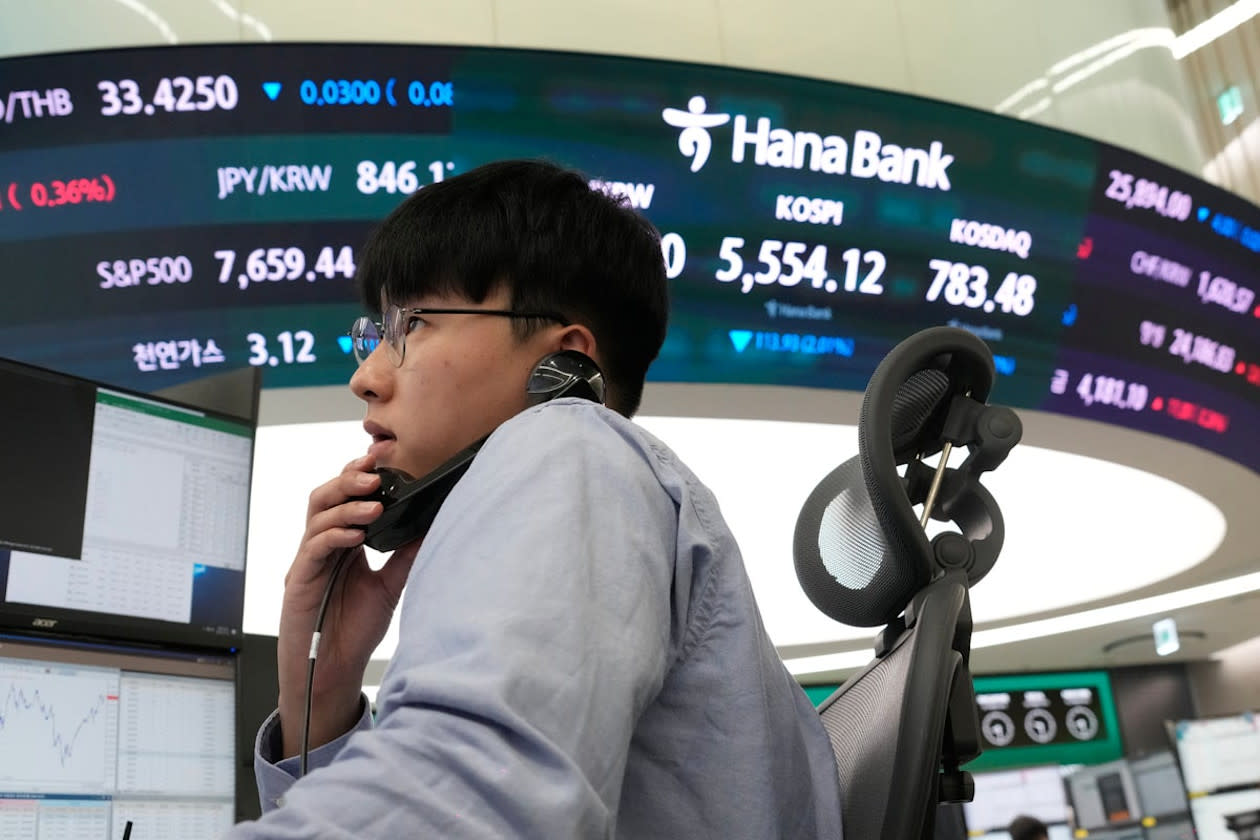

Asian tech stocks sank on Tuesday as the US tightened China's access to advanced AI chips, dealing another blow to the already battered AI trade.
Asian tech stocks tumbled as fresh US chip restrictions added to growing doubts about the AI trade.
Chinese AI developers fell, but domestic chipmakers rallied on hopes of a boost from Beijing's tech push.
Nvidia's upcoming earnings are the next big test for an AI trade already under pressure across Asia.
Chinese AI developers were among the hardest hit. Hong Kong-listed Z.ai, the company behind the viral Ox Alpha model, fell as much as 6%, while tech giants Alibaba and Tencent lost 6% and 3%, respectively.
But China's domestic chipmakers moved in the opposite direction.
Shares of SMIC and Hua Hong surged 9% and 16%, respectively as investors bet that tighter US restrictions could accelerate China's push to develop its own semiconductor industry.
The divergence highlights how Washington's latest restrictions could create winners and losers within China's AI sector, even as concerns about the technology's outlook weigh on stocks across Asia.
"What benefits China's domestic chipmakers may simultaneously hurt its AI developers," Charu Chanana, the chief investment strategist at Saxo, wrote in a note on Tuesday.
Elsewhere in the region, South Korean chipmakers Samsung Electronics and SK Hynix fell as much as 3% and 2%, respectively, before paring losses.
Japanese chipmaker Kioxia and chip-testing equipment maker Advantest dropped 7% and 6%, respectively.
The declines followed a bruising session on Wall Street, where the Philadelphia Semiconductor Index tumbled more than 5% on Monday as investors grew increasingly nervous about the AI trade ahead of Nvidia's earnings.
Widening risks
The latest US restrictions target a workaround that has allowed Chinese companies to access advanced chips by renting computing power from overseas data centers rather than buying the chips directly.
The rules add new licensing requirements for advanced AI chip shipments to countries including Singapore, Malaysia, and Brazil.
"This is a meaningful escalation because restrictions are moving beyond who can buy advanced chips to who can access their computing power remotely," Chanana wrote.
For Chinese AI developers, the restrictions could raise computing costs and slow development. They could also dampen future demand for advanced processors and high-bandwidth memory used in AI data centers.
The restrictions come at a difficult time for Nvidia, whose shares fell 4% on Monday amid a leadership crisis following CEO Jensen Huang's resignation last week. The stock has lost about a third of its value since its October peak.
"For Nvidia, the bigger risk may be future demand rather than an immediate earnings hit," Chanana wrote.
The chipmaker is due to report quarterly earnings after Tuesday's US market close, its first under interim CEO Colette Kress.
Nvidia's outlook carries particular weight in Asia, where Taiwan's TSMC manufactures its advanced processors and South Korean chipmakers supply memory used in AI servers.
The selloff also comes amid broader questions about whether the massive spending on AI infrastructure will generate the returns investors expect.
Within China, however, the impact of the latest US restrictions could be more uneven.
Domestic chipmakers such as SMIC and Hua Hong could benefit from stronger demand and policy support as Beijing seeks to reduce its reliance on foreign technology, according to Chanana.
"The AI trade may not be ending, but the assumption that every part of the value chain benefits equally is becoming harder to defend," she wrote.
This article was written by htan@businessinsider.com (Huileng Tan) from Business Insider and was legally licensed through the DiveMarketplace by Industry Dive. Please direct all licensing questions to legal@industrydive.com.