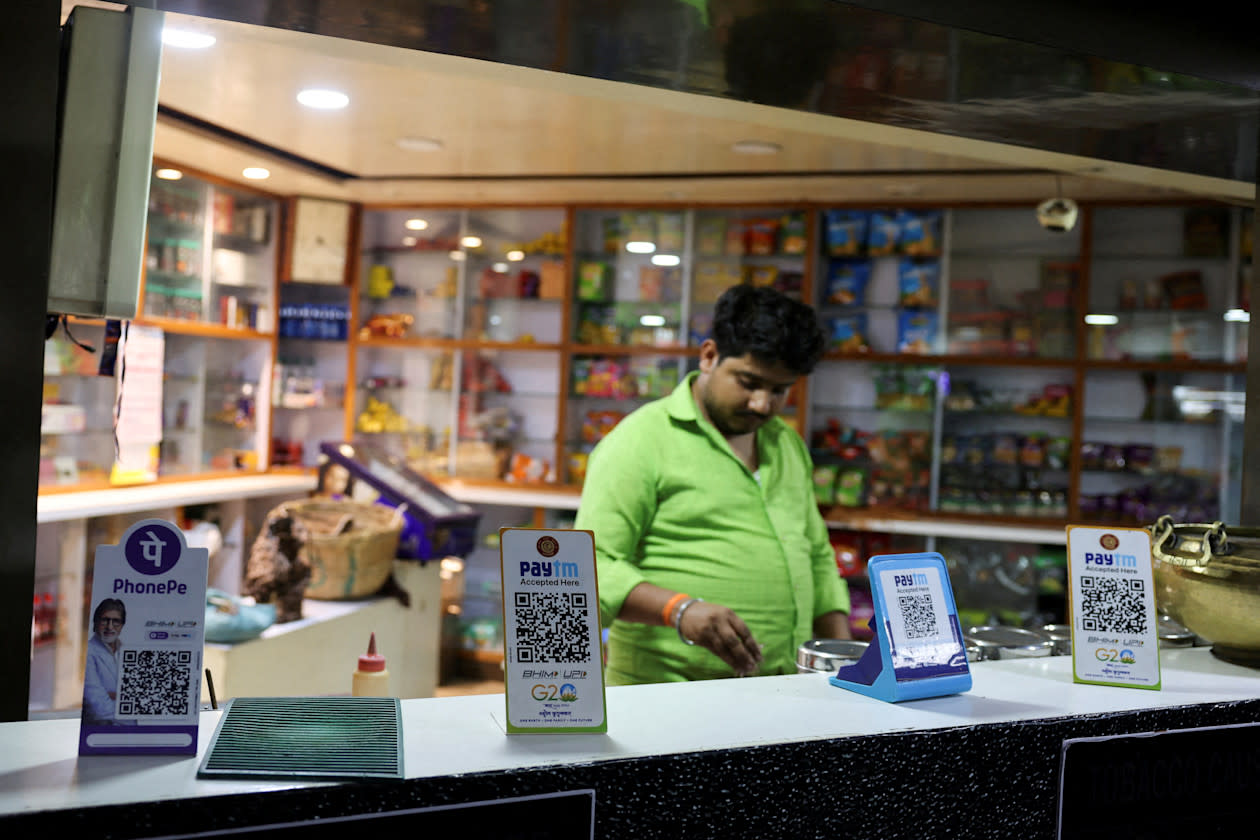

Using mobile phones to scan a QR code for payments has become near ubiquitous behaviour in India over the last decade, thanks to a widely used homegrown network, the Unified Payments Interface (UPI).
But after six years of free use, regardless of size or type of payment, India has decided to start charging merchants a fee of 0.4% for transactions of more than 2,000 rupees ($21), known as the Merchant Discount Rate (MDR), with some exclusions, though person-to-person transfers remain free.
Shares of Indian payment firms rose on Wednesday as investors saw the MDR opening fresh revenue lines for banks and payment firms that have so far absorbed the costs of such transactions.
How big is UPI?
In August, UPI processed a total of 24.5 billion transactions worth 29,823 billion rupees for more than 550 million users, official data show.
UPI has a share of 84% in India's digital payments by volume and a 49% share of global real-time payment volumes, the government said on Tuesday.
Walmart's PhonePe and Alphabet's GooglePay had about 80% market share by value of UPI transactions in August.
Was UPI always free?
Its pricing model at launch in 2016 included nominal charges temporarily waived in 2017 when India demonetised a large chunk of its high-denomination currency notes.
In 2020, all charges were scrapped, kicking off a zero-MDR regime set to end on October 15, 2026.
What fee will be imposed?
A fee of 40 basis points applies to transactions above 2,000 rupees with merchants, along with carve-outs for payments to small merchants and those operating in rural or semi-urban areas. Widely used categories such as telecom, railways and mutual fund or stock investments will attract lower charges.
Fees are capped at 300 rupees on transactions exceeding 75,000 rupees.
Will consumers pay the fee?
While the National Payment Corporation has said merchants cannot pass on the fee to consumers directly, critics fear they will eventually pass on the charges to customers.
Merchants pay the fee to banks that process the transactions with a portion also passed on to payment apps, such as Google Pay and PhonePe, that facilitate such payments.
What criticism does it face?
India's opposition party, Congress, has criticised the government's decision, with opposition leader Rahul Gandhi saying the fees will swell the burden for consumers as merchants pass on the cost.
Social media users have also voiced concern that the change could prompt merchants to prefer cash payments, questioning the rationale for levying charges to use "digital public infrastructure," as the government has termed it in the past.
Why does UPI need the merchant discount rate?
India's government, the central bank and payments authority say, the MDR will help make UPI self-sustainable, give a fillip to expansion in rural and semi-urban areas, and keep a large majority of payments free of charge.
($1=95.9275 rupees)
(Reporting by Jaspreet Kalra; Editing by Clarence Fernandez)
Copyright (2026) Thomson Reuters.
This article was written by Jaspreet Kalra from Reuters and was legally licensed through the DiveMarketplace by Industry Dive. Please direct all licensing questions to legal@industrydive.com.