How to build a portfolio
We take a closer look at how to build an investment portfolio with the right mix of assets, known as asset allocation.
In this guide
What is asset allocation?
How to choose your investment goals
How much risk should you take?
Choosing investments
Portfolio diversification
Rebalancing your portfolio
Frequently asked questions
The right investment portfolio for you will depend on your goals, how long you plan to invest and your attitude to risk.
Your investment strategy should be one that matches your objectives and risk appetite and aims to achieve the best return for your chosen level of risk.
This guide isn’t personal advice. If you’re not sure what’s right for your circumstances, our financial advisers can help.
What is asset allocation?
It's about choosing investments that match your goals and how much risk you're comfortable taking. This involves spreading your money across different types of investment, such as shares and bonds.
If you're investing for ten years or more, you might consider a more adventurous portfolio with a greater allocation to shares. Although shares can be more volatile in the short term, they have historically offered greater growth potential over the long term.
If you think you’ll need access to your money sooner, a more cautious portfolio with fewer shares and more bonds could be a better fit, as bonds have historically been less volatile than shares.
The more volatile an investment is, the riskier it is because it’s likely to move up and down in value more. All investments rise and fall in value, so you could get back less than you invest. Investing is for the long term, typically 5 years or more.
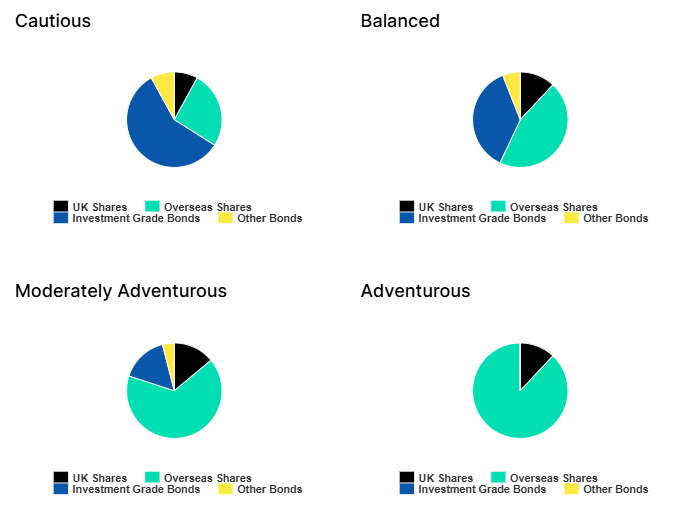
Portfolios can be built in lots of different ways. Here are a few examples:
Cautious – more bonds, fewer shares
Balanced – a mix of shares and bonds
Moderately adventurous – more shares than bonds
Adventurous – mostly shares, with little or no exposure to bonds
These portfolios do not consider cash, however it’s important to build up an emergency savings pot before you start investing.
If your circumstances change, we’d recommend reviewing your investment strategy and objectives. You should plan to hold all investments for the long term too – that’s at least five years.
What are ready-made investments?
Ready-made investments are professionally managed portfolios that combine a range of funds into a single investment. They're designed to make investing simpler, especially for those who'd prefer not to choose and manage investments themselves.
You choose an option that matches your goals and attitude to risk, while a team of investment experts looks after the day-to-day decisions and management – you’ll need to keep track from time to time on whether the investments continue to meet your goals.
What are the different types of assets?
Broadly speaking, assets consist of shares, bonds, property and commodities such as gold. And while there are lots of ways to define an asset class, it’s their characteristics which really matter.
Investments in an asset class are broadly similar to one another. For example, UK shares are one asset class. Directly owning shares give investors part-ownership of a company and are listed and traded on the London Stock Exchange. Shares will sometimes pay out a share of profits in the form of dividends – but these can vary and aren’t guaranteed.
UK corporate bonds don’t provide investors with ownership of the company. They’re one of the ways a company raises money for things like investment or paying down debt. And in exchange, the company agrees to pay investors a set amount for the duration of the bond.
Unlike shares, bonds pay out a fixed income, and it’s these kinds of differences that make shares and bonds separate asset classes.
The addition of an extra asset class to a portfolio, such as bonds, property or gold should help reduce the risk of poor performance by smoothing some of the ups and downs in your portfolio. This is an important characteristic for an investment strategy, and why diversification is often championed by many investors.
Four steps to building an investment portfolio
1. Know your objectives
It’s important to know what you want to achieve by investing. This could be generating an income in retirement, building a house deposit or contributing towards your children’s university fees.
Knowing your objectives will help define how long you’ll need to invest and the returns you're aiming for.
2. Choosing your risk
Your risk level should be based on your long-term financial needs rather than short-term market movements. Your strategy and mindset should also be able to withstand the ups and downs of investing.
As a general rule, investors who are saving for the long term, such as those saving for their pension and who are many years from retirement can often afford to take greater risks by investing more in shares. Those approaching retirement may prefer to increase their exposure to bonds, which typically offer less fluctuation in returns.
That said, many of us live for more than two decades after retiring. So, it's often sensible to continue holding some shares in retirement to diversify where income is coming from and to maintain growth in a portfolio.
3. Choose your assets and investments
Picking the right mix of shares and bonds is arguably the most important part of the process.
Shares are generally riskier than bonds but offer greater growth potential. Bonds tend to provide a more predictable source of income and can play a larger role in portfolios where preserving wealth is a priority.
Getting your share-to-bond ratio right is key. The next step is to diversify.
Diversification works because different investments are exposed to different risks and drivers of returns. For example, shares in developed markets carry different risks and drivers of returns to those in emerging markets.
Once you've decided your asset allocation, you'll need to select investments within each asset class. While risk and return are closely linked, combining different investments can help lower volatility risk should one investment underperform.
Find out more about diversification
4. Review and rebalance regularly
To keep your portfolio aligned with its objectives, you'll need to check in and rebalance it once or twice a year.
Rebalancing simply means keeping your portfolio on track. If some investments have grown faster than others, you might sell a little of what's done well and reinvest elsewhere.
Sometimes this will mean selling bonds and buying shares, and sometimes the reverse. You might also rebalance individual holdings if one investment grows to become a larger part of your portfolio than you originally intended.
Why sticking to your investment strategy matters
In times of uncertainty, it’s important for investors to hold their nerve and think long term.
It’s impossible to predict exactly when a major market will happen. But by selling your investments after they’ve fallen in value, you miss out on the potential for them to bounce back when prices eventually recover.
And while we don’t know what’s around the corner, we do know investing for the long term, and sticking to your game plan offers you the best chance of achieving your goals and securing a better financial future.
Need help getting started?
Whether you'd like to make your own investment decisions or receive personalised advice, we offer different ways to help you build your portfolio.
The Wealth Shortlist
Funds selected by our research team for their long-term potential to help investors build their own diversified portfolio.
Get personalised advice
An HL financial adviser can recommend investments based on your individual circumstances and goals.
How to build a portfolio Frequently Asked Questions
You can start investing with relatively small amounts. What's most important is choosing investments that match your goals and risk tolerance rather than trying to invest a large lump sum.
A beginner portfolio will often focus on diversification, spreading investments across different asset types, sectors and regions to help manage risk. Many beginners use funds or ready-made investments to achieve this.
Many investors rebalance their portfolios periodically (once or twice a year), and review it when they have a change in their personal circumstances, to ensure they continue to match their intended asset allocation and risk level.