

Britain’s new Prime Minister has moved quickly to remove VAT from electricity bills. Getting the UK economy back on track will take some more ambitious steps, but focusing on energy affordability is a prudent place to start.
As well as struggling households, UK industry and businesses face electricity prices that are 45% above the G7 median, weighing on productivity, competitiveness, and the wider economy.
This article isn’t personal advice. If you’re not sure an investment is right for you, seek advice. Investments and any income from them will rise and fall in value, so you could get back less than you invest. Ratios also shouldn’t be looked at on their own.
So, why are energy bills so expensive?
There are many reasons.
Each part of our energy cost pie has different challenges that weigh on affordability. But our reliance on natural gas, steep investment in our network, and the nature of our wholesale market are core to understanding the puzzle.
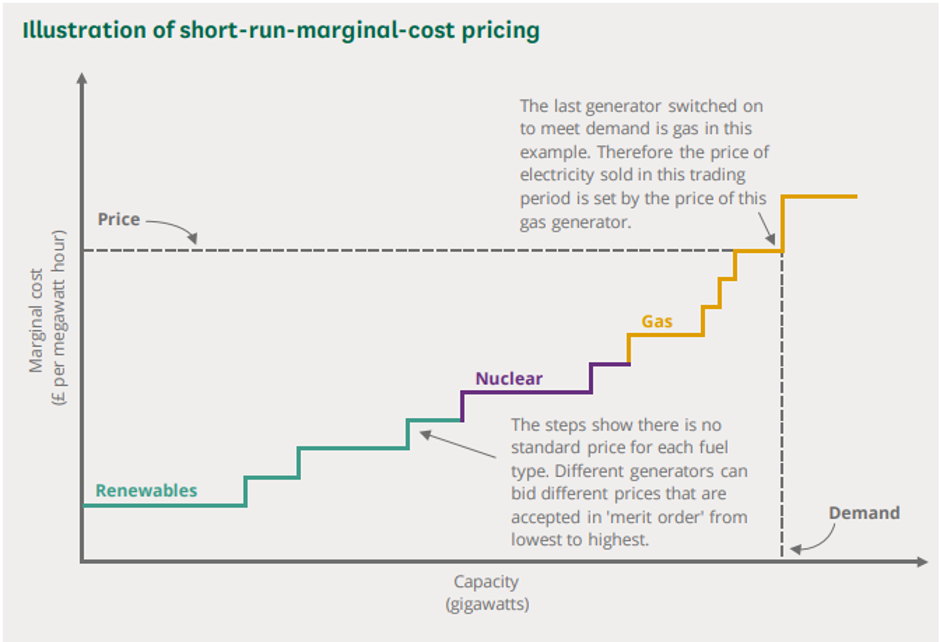
Wholesale costs are the price we pay for power as a commodity. Great Britain has a marginal pricing system. Simply put, it means everyone pays the same price, which is set by the last and most expensive form of generation to meet our energy demands. This is where our reliance on gas bites, as it’s often the most expensive source.
Network costs relate to energy distribution, transmission and balancing of electricity across Great Britain. The current grid was largely designed around a small number of large power stations located close to towns and cities.
But renewable energy's share of UK electricity generation has risen from 2.8% in 2000 to a record 52.5% in 2025. And generation is increasingly concentrated in places like the North Sea and northern Scotland, often far from where the power is consumed.
As a result, electricity needs to travel longer distances through a network that wasn't designed for it. On particularly windy days, the grid can struggle to move electricity from where it's generated to where it's needed.
In some cases, wind farms are paid to reduce output because the network lacks sufficient capacity. These so-called constraint or imbalance costs now account for nearly 5% of a typical electricity bill, and that figure could continue rising without significant investment in grid infrastructure.
Why is the UK investing in grid upgrades?
While this creates a positive scenario for companies and investors focused on network upgrades, it raises the question: why is Great Britain undertaking this fundamental and very expensive transition?
These are best split into risks and opportunities.
Risks of the UK energy transition
The risks are threefold.
Firstly, we are overly dependent on volatile gas imports, hitting affordability. As it often sets the price of power in Great Britain, it raises the price of all electricity.
Secondly, in a more geopolitically unstable era, how we define security of supply has fundamentally changed. The focus has shifted to securing a domestically sourced supply.
And finally, global temperatures are rising affecting industries like farming, insurance and utilities. Decarbonising our energy supply will be critical for long-term sustainable planning. Research suggests that avoiding climate damage is the most significant benefit of the transition, with potential savings ranging from £40bn to £130bn in 2050.
Opportunities from the UK energy transition
The opportunities are the inverse of many of the risks.
Renewable generation offers homegrown energy that’s cheaper than gas. The net zero economy generated over £100bn of ‘Gross Value Added’ in 2025, via the direct production of goods and services and by stimulating demand among suppliers and employees.
On top of that, a recent study suggests that £34bn of investment in the UK grid over the next 15 years could unlock £194bn of economic output by 2040.
Where are the investment opportunities?
All of this comes with caveats, and there are no free lunches. But it seems that whatever the UK government's approach, there will need to be investment in grid infrastructure to adapt to the age of electrification. Whether it’s homegrown renewable energy, heat pumps, EVs, or data centres that dictate change, the grids will need to adapt.
That fundamental shift in our energy system positions some UK-based companies to benefit from what might be a period of unprecedented investment.
Investing in an individual company isn’t right for everyone because if that company fails, you could lose your whole investment. If you cannot afford this, investing in a single company might not be right for you. You should make sure you understand the companies you’re investing in and their specific risks. You should also make sure any shares you own are part of a diversified portfolio.
National Grid – picks and shovels
National Grid owns and operates critical electricity and gas infrastructure across the UK and northeast US. It doesn’t rely on higher energy prices or the success of a particular power generation technology. Instead, the group earns a return from building and operating the energy infrastructure that moves power around the country.
As demand from electric vehicles, heat pumps and data centres rises, and renewable generation continues to expand, the grid needs more capacity to move power around the country effectively. That’s seen National Grid lay out plans to invest more than £70bn over the five years to 2031, with more than half of that total focused on the UK.
These investments are expected to help the group’s asset base grow by around 10% annually out to 2031. And with revenues linked to the value of its asset base, National Grid’s targeting annual earnings growth of 8-10% over the period, which looks achievable to us.
While that’s a lot of cash going out the door, relatively reliable revenues and prior equity raises mean the balance sheet should remain in decent shape. There’s also a 4.1% forward dividend yield on offer, which is expected to grow in line with inflation. But of course, no shareholder returns are guaranteed.
National Grid offers one of the clearest ways to gain exposure to long-term electrification trends, without taking direct exposure to power prices or renewable generation. The valuation has fallen in recent months and looks relatively undemanding to us. But given the scale of the investments ahead, project delays and cost overruns are key risks to monitor.
SSE – the hybrid play
SSE offers exposure to the same electricity network growth story as National Grid, while also providing a direct stake in renewable generation and gas-fired power plants.
The group’s looking to drive the energy transition forward, with plans to invest £33bn over the five years to 2030. Around 80% of that total is earmarked for its regulated electricity networks. Because this division’s revenues are linked to the value of these assets, the investment programme should help provide a strong foundation for future earnings growth.
Much of this investment is focused on northern Scotland, home to some of the UK's richest renewable energy resources. As more renewable generation comes online, additional network capacity is needed to connect that power to homes and businesses across the country, creating a significant opportunity for SSE.
Unlike National Grid, SSE can also benefit directly from generating electricity. Renewable assets were the group's largest profit contributor last year, accounting for almost half of its £2.2bn underlying operating profit. When wind conditions are favourable and power prices are supportive, these assets can help accelerate earnings growth.
The trade-off is that earnings can be more volatile than those of a pure network operator. Renewable generation remains exposed to factors like wind conditions and power prices – both of which are outside of management’s control.
SSE’s hybrid approach to the energy transition offers the potential for double-digit earnings growth over the coming years. Despite the strong outlook, the valuation is toward the bottom end of the peer group. We see scope for this gap to close if SSE can deliver its investment plans. But renewable generation brings greater uncertainty, and the scale of the investment programme adds execution risk.
This article is original Hargreaves Lansdown content, published by Hargreaves Lansdown. It was correct as at the date of publication, and our views may have changed since then. Unless otherwise stated estimates, including prospective yields, are a consensus of analyst forecasts provided by LSEG. These estimates are not a reliable indicator of future performance. Past performance is not a guide to the future. Investments rise and fall in value so investors could make a loss. Yields are variable and not guaranteed.
This article is not advice or a recommendation to buy, sell or hold any investment. No view is given on the present or future value or price of any investment, and investors should form their own view on any proposed investment.