Retirement planning: everything you need to know
Retirement planning means thinking about the lifestyle you want, how much income you'll need, and where that money will come from. And a good retirement plan balances security with flexibility, so you can enjoy the future that you have saved for.

We believe in six important principles when planning your retirement, to help make sure that you earn a sustainable income:
Plan for the retirement you want, not someone else’s.
Work out the income you’ll need and expect your spending to change.
Decide how you’ll take an income and when to use your tax-free cash.
Consider bringing your pensions together before you retire.
Take your retirement income tax-efficiently.
Get help when you need it and review your plan regularly.
Important information: This isn’t personal advice. If you’re not sure what’s best for you, then please ask us about advice. Investments can fall as well as rise in value, so you could get back less than you invest. Tax benefits depend on your circumstances, and rules can change.
Designing a retirement strategy that works for most people
How to make a retirement plan
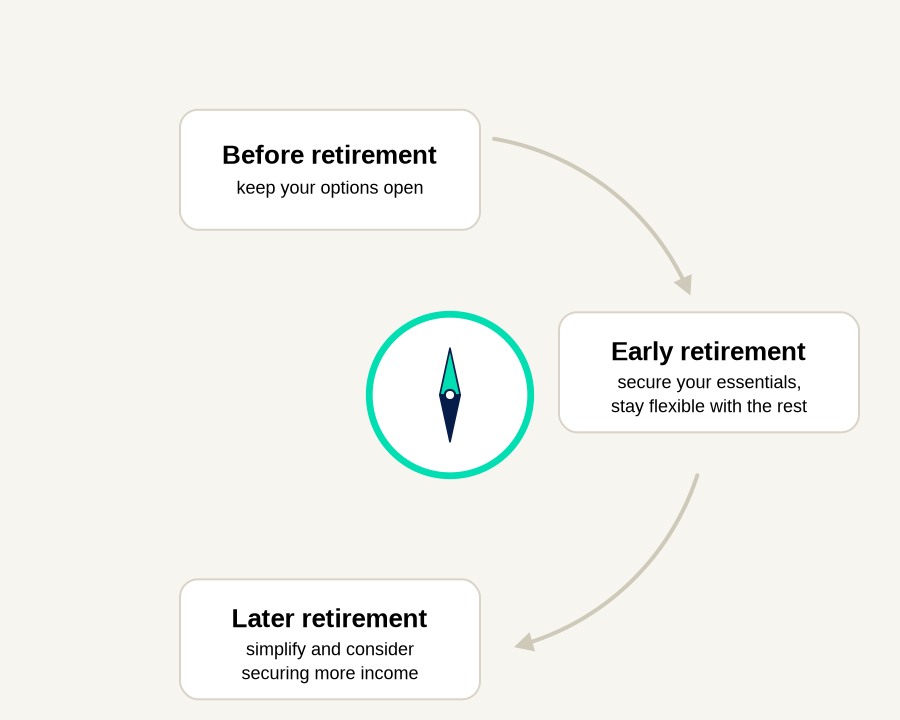
Splitting retirement into phases helps. As you move through them, your need for flexibility and certainty shifts, so adapt your plan as you go.
Semi-retirement
You’re winding down before stopping work. You may be cutting your hours and starting to draw on assets in order to top up your income.
Keep your options open. Locking into an annuity now could cause problems later, while your circumstances are still changing.
Consider taking income from your savings, investments, or pensions to supplement your earnings. Money in a pension is usually accessible from age 55 (57 from 2028).
Want to keep paying into your pension? Think carefully before taking taxable income via income drawdown or UFPLS. It triggers the Money Purchase Annual Allowance, which cuts your annual contributions to just £10,000.
Early retirement
We class early retirement as the day that you stop work entirely until age 75. You’ll still want some flexibility, but your priority is securing your essentials with guaranteed income.
Pin down your guaranteed income. Will it come from the State Pension, a final salary pension, or an annuity? If you choose an annuity, then use an annuity search engine to get the best rate and include all your health data on the form – it can boost your income.
Use income drawdown and other investments to fund the non-essential spending.
If you draw an income through drawdown or other investments, then set a sensible withdrawal rate. Don’t risk running out of money later. Review regularly, and accept that there will be times – such as market falls – when you need to take less.
Later retirement
This typically starts about age 75. Most people start to benefit from more certainty with regard to income – perhaps because they’re doing less or want simpler finances. They may also be less willing to take investment risk.
Consider converting some of the rest of your retirement savings into a guaranteed income with an annuity.
Age can work in your favour: older buyers tend to get higher annuity rates and a better income, although many factors can influence the rates that you receive. If you have a health condition that qualifies you for an enhanced annuity, then your income gets a further boost.
A simpler financial strategy is easier for you and your family to manage.
What is a good retirement income?
Ignore the headline figures in the press when working out how much income that you might need for retirement. They are guides, not targets – everyone’s retirement is different, so there is no single number. Start with what you actually need. First, your essentials: food and bills. Then your non-essentials: travel and leisure. Together, they tell you what income it takes to fund the lifestyle you want.
| Essential | Non-essential |
|---|---|
| Housing: rent or mortgage, plus property tax and basic repairs | Dining out and takeaways |
| Utilities: electricity, gas, water, heating | Streaming services and subscriptions |
| Groceries and basic household supplies | Clothing beyond what you need, and impulse purchases |
| Transport: fuel, public transport, or car payments and insurance | Travel and holidays |
| Care services, subscriptions not covered under the NHS | Hobbies, gadgets, and entertainment such as concerts or games |
| Debt payments: credit cards, loans | Gym memberships or premium app tiers |
| Insurance: home, car, and life where required | Gifts beyond occasions you care about |
| Phone and internet | Upgrades like a newer phone or a larger home when the current one suffices |
Your circumstances matter. If you’re single, then you carry every cost alone. If you have a partner, then agree what you both want and how costs will be shared. Our online Retirement Spending Predictor will help you work out how much you will need.
Work out how much you might need in retirementHow does spending change in retirement?
Our experience shows that lifestyles change through retirement, and income needs change with them. Early on, people are more active, so spending is higher. Later, life slows down and they need less. Build that into your plan.
Essential spending – bills and food – stays broadly the same. It’s the discretionary spending, such as holidays, that fall. Our research shows that non-essential spending drops by about 10% for couples and 3% for single people between the early and later retirement years. The message is clear: spend confidently early on because you are very likely to need less later.
Key issues to weigh when planning your income:
Inflation. The cost of essentials will keep rising. Balance the lifestyle that you want today against the costs you’ll face tomorrow.
Losing a partner. You may plan retirement together, but you must also plan for relationship breakdown or bereavement. Rely on one partner’s assets and the other can be left exposed, meeting the full cost of essentials alone. Test whether you’d have enough if you were suddenly single.
Potential care needs shouldn’t dominate your retirement plan, but they’re still important to consider. Planning ahead, including keeping a cash buffer, can help you understand how care costs could affect your finances and keep your plan flexible if your circumstances change.
How to take an income in retirement
Both annuities and income drawdown have a role, and the right choice depends on your circumstances. It isn’t either/or. Used together, annuities and drawdown deliver a powerful mix of flexibility and security.
Annuities secure a guaranteed income for life. They bring valuable peace of mind for anyone who doesn’t want to ride out stock market volatility and can be used to lock in essential spending in early retirement, then annuitise in stages as you age.
Always get a range of quotes when you review – once bought, an annuity can’t be changed, so consider your options carefully. Using an annuity search engine can get you a range of quotes from across the market quickly. Give as much information as possible about your health and lifestyle in order to secure the best income. Annuity quotes are guaranteed for a limited time, and rates can change regularly.
Income drawdown offers valuable flexibility and can play a central role once your essential spending is secured. But you must be comfortable with investment volatility and with an income that changes over time. There is also a risk that you could run out of money if you take too much income or if markets fall. Review your strategy at least annually to keep your income sustainable. With drawdown, you’ll need to be comfortable with your pension rising and falling in value and understand how this could affect your retirement income.
Remember, although investments usually outperform cash savings over five years, values rise and fall, so you could get back less than you invest.
Learn more about annuitiesShould you consolidate your pensions before retirement?
You will build up several pensions during your career, but managing multiple pots is time-consuming and can lead to poor decisions. Hold several small pensions and you may be tempted to cash them in and spend them; streamlining them into one or two pots means that you’re less likely to as you've got a better idea of what you have. Drawing from several pots is also messy and harder for your family to deal with when you die.
Finding a retirement home for your pensions leads to better retirement decisions. It matters most within 10 years of accessing your pension: line your pensions up with a provider that gives you flexibility in how you take your income.
Before you consolidate, check:
What support is available to help you plan for retirement?
What options do you have for drawing an income?
Do they offer the investment choice you need?
How do the investment approaches compare across your plans?
Costs and exit charges.
Make sure that consolidating is definitely right for you. Some older pensions carry valuable benefits that you could lose. These include:
Guaranteed annuity rates
Some pensions carry guaranteed annuity rates significantly higher than you could get elsewhere. Transfer, and you could lose out. If you have a guaranteed rate, you can accept it and use other assets or pensions to secure extras such as a spouse’s pension.
Defined benefit pensions
Transferring out of a defined benefit pension rarely makes sense. It delivers a guaranteed income for life that will usually include some protection against inflation, although exactly how your income increases will depend on your scheme. If your defined benefit pension has a transfer value of more than £30,000, then you’ll usually need to get financial advice before you can transfer it.
Pensions with guaranteed fund returns
These are uncommon, but depending on the terms, they could be worth keeping.
Pensions offering enhanced tax-free cash
Set up before 2006, these allow more than the current 25% to be taken tax-free. Still, ask whether the pension offers the best value overall – including the flexibility you need.
Beware of exit penalties
Modern pensions charge little, if anything, to transfer. Older pensions can carry larger fees that take a chunk out of your savings, including Market Value Reductions on With Profits funds. If you’re 55 or over, then early exit charges on personal pensions taken out before 31 March 2017 are capped at 1%, so transferring can still make sense.
Ongoing employer contributions
Thinking of transferring out of your workplace scheme? Check whether you can keep your employer contribution in the new scheme. Some schemes allow it; most don’t. Employer contributions are vital to building your pension, so consider waiting until you’ve left their employment and the contributions have stopped before you transfer.
When should you take your pension tax-free cash?
Don’t take your tax-free cash just because you can. Make it part of a longer-term plan. Pensions are a highly tax-efficient environment, so think carefully before drawing money out. Take it as spending needs arise and keep the rest invested.
By age 75, most people should have taken their tax-free cash. If you die before taking it, then your beneficiaries could be taxed on it.
Tax-free cash has faced intense media speculation in recent years. Don’t let short-term rumours undermine years of planning. We think that retrospective changes are highly unlikely, though we can never rule change out completely.
If you’re still concerned, be pragmatic:
Reinvest money that you don’t need using your ISA allowances.
Keep funds invested rather than holding excessive cash.
Be wary of reinvesting into your SIPP – you risk triggering the recycling rules. Speak to a financial adviser first.
How to take retirement income tax-efficiently
Use the tax allowances across all your assets – pensions, ISAs, savings and other investments – and weigh them up together. Review your strategy regularly as tax rules change and benefits depend on your circumstances, and tax rules can change.
Key principles:
Avoid large one-off withdrawals – you could pay more tax or be pushed into a higher tax band.
Don’t sell investments in one go and trigger a tax charge when you could spread sales over several years.
Use your allowances across all your assets. Taking income from a variety of sources can be better than relying on just one.
Getting help with retirement planning
Everyone needs a retirement plan, but how you build it is up to you. Some people want a financial adviser; others are happy going it alone. It comes down to your confidence and how complex your affairs are. However, it’s important to remember that this isn’t personal advice. If you’re not sure what’s best for you, then please ask us about advice.
It’s our view that retirement is the point in life when you are most likely to benefit from advice. The decisions are important, the issues are complex, and it’s vital to think through the consequences.
Many people speak to an adviser to give them confidence and clarity that they are on track to reach their retirement goals. An initial call with one of our financial advisers is free, and no advice will be given. If you decide to proceed with financial advice, then charges will apply.
Book a call with one of our financial advisers to discuss your optionsOther support is available. From age 50, Pension Wise offers free, impartial guidance on your options. Even if you think that you’ve got it all worked out, use it – a second opinion is valuable.
More about Pension WiseHow often should you review your retirement plan?
Tax rules change, markets fall and life moves on. Check your plan:
Every year.
After life events such as the death of a partner, relationship breakdown, or an inheritance.
After significant market falls – you may need to take less income for a period when you are retired.
When there are major changes to pensions or tax rules.
At age 75, when tax rules change – a good point to check whether your needs have changed.
Retirement planning FAQs
An annuity is a retirement product offered by insurance companies that turns a portion or all of your pension savings into a regular, guaranteed income. The income will be paid for the rest of your life.
Pension drawdown means withdrawing money from your pension while leaving the rest invested. You choose how much income to take, but it isn't guaranteed and your pension could run out if you withdraw too much or your investments underperform.
An annuity gives you a guaranteed income, whereas drawdown offers more control over your pension. Which is better for you will depend on whether you’re looking for flexibility or certainty, and it doesn’t have to be one or the other. Using a mixture of the two could give you a combination of guaranteed income and flexibility.
Pension tax-free cash refers to money you can take from your pension without paying Income Tax. You can usually take up to 25% tax-free, subject to applicable allowances, all at once or in different stages.
Yes, you may pay Income Tax on your pension. You can usually take up to 25% tax free, and the rest might be taxable depending on your income.
The State Pension is a regular payment from the UK Government that you can claim once you reach State Pension age, provided you're eligible. The State Pension age is currently 66, although it’s gradually increasing to 68 by 2046. How much you receive generally depends on your National Insurance record.