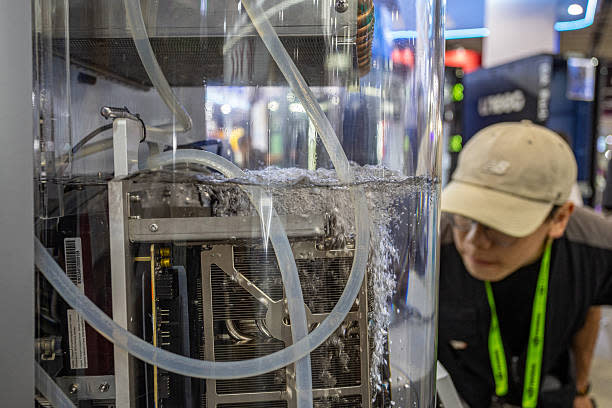


This year, the United Nations warned that the world has moved beyond a water crisis and entered an era of "water bankruptcy". Driven by decades of groundwater over-extraction, pollution, deforestation and climate change, many regions now have water systems depleting faster than they can recover.
This article is for information only and not personal financial advice. If you’re not sure what’s right for you, a financial adviser can help.
Why water scarcity is becoming a major economic risk
Within the next 30 years, England is expected to face shortfalls of five billion litres a day. And the economic consequences are already being felt, with the recent heatwaves exposing the vulnerability of critical infrastructure.
Across Europe, water-related constraints forced temporary shutdowns at several river-cooled nuclear power plants, just as electricity demand for air conditioning surged. Meanwhile, drought conditions have damaged UK agricultural yields, increasing retailers' reliance on more expensive imports.
The implications extend far beyond the environment, our energy supply, and food systems. The UK Government has identified water insecurity as a threat multiplier, citing potential links to migration pressures, geopolitical instability, political polarisation, and conflict.
At the same time, competition for water is intensifying. Agriculture is still the world's largest consumer, but demand from power generation, manufacturing and growing urban populations is rising.
And amidst all this, Big Tech is emerging as an unlikely competitor. The rapid expansion of artificial intelligence (AI) is driving unprecedented investment in semiconductors and data centres, both of which are highly water dependent.
The hidden water footprint of AI infrastructure
Across this year and next, Amazon, Google, Meta and Microsoft are expected to spend a staggering $1.5tn building data centres and filling them with advanced chips.
Semiconductor fabrication requires vast quantities of ultrapure water, with the average chip manufacturer using as much water as 33,000 US households every day. During the manufacturing process, silicon wafers are repeatedly cleaned and rinsed to remove impurities, making water a critical input in chip production.
By contrast, data centres are increasingly relying on water for cooling. Although many operators are investing in recycled and reclaimed water sources to reduce dependence on freshwater supplies, in the UK, it’s still estimated that data centres could use up to 20 million litres of drinking water a day by 2030. This is roughly equivalent to the daily water needs of Exeter.
As water scarcity evolves from an environmental challenge into a strategic economic risk, investors should ask not only whether access to water could constrain the growth of companies powering the AI revolution, but also how societies will prioritise an increasingly scarce resource.
As competition for water intensifies, difficult questions may emerge around trade-offs between industrial growth, ecosystem resilience and the water needs of growing communities.
The following case studies show how water pressures are already affecting two companies central to the AI supply chain and how each is responding.
Taiwan Semiconductor Manufacturing Co (TSMC)
TSMC is the world’s leading semiconductor manufacturer, producing and assembling chips for clients like NVIDIA, ARM, and Apple rather than designing its own.
As a result, TSMC’s manufacturing processes require enormous volumes of water. The firm’s water usage has increased in the last few years to 151 million m3 in 2025 – equivalent to about 60,000 Olympic-sized swimming pools.
The industry's dependence on water was brought into sharp focus during Taiwan's 2021 drought. Faced with critically low reservoir levels, the government prioritised water supplies to semiconductor manufacturers while imposing restrictions on other industrial users, narrowly avoiding a global chip crisis.
Recognising water as a financially material risk, TSMC has since made becoming "water positive" a long-term strategic goal. The company aims to replenish as much water as it withdraws, targeting 65% water positivity by 2030 and 100% by 2040.
In practice, its new semiconductor facility in Phoenix, Arizona, is being designed to recycle about 65% of the water it uses, reducing its reliance on municipal supplies in a region already facing water scarcity. However, it’s estimated that the firm will still be the city’s largest tap water customer.
Water will remain a critical input for semiconductor manufacturing, but for TSMC, the challenge will be on innovating production processes to reduce reliance on freshwater through recycling, reclaimed water and diversified water sourcing.
For investors, the key question is whether water efficiency gains can keep pace with rising semiconductor demand, or whether water scarcity could ultimately constrain future growth.
Microsoft
Microsoft operates the infrastructure powering the AI revolution. Through its Azure cloud platform and partnership with OpenAI, the company is investing heavily in new data centres to support the rapid growth of AI applications.
Recognising the potential risks, Microsoft has committed to becoming "water positive" by 2030. The company is investing in water-efficient data-centre designs and alternative cooling technologies while also targeting a 40% improvement in data-centre water-use intensity by 2030.
Microsoft's water withdrawals have increased in the past five years, reaching 13.3 million m³ in 2025. Despite this, the company has made strong progress towards water positivity and by expanding its water replenishment efforts, replenished more water than it withdrew last year.
Replenishment can help address the irreversible damage of “water bankruptcy”. However, it does little to address short-term pressures on local water supplies.
In the UK, data centres are classified as critical national infrastructure, meaning that they can continue to use water whilst households face restrictions during periods of drought.
As AI infrastructure expands into increasingly water-stressed regions, investors may need to look beyond replenishment targets and assess whether companies are reducing demand and maintaining their social licence to operate.
Microsoft’s new data centre in Amsterdam, which uses rainwater, is a prime example of how data centres can reduce their dependence on freshwater resources. The new system is expected to collect more than three times the water annually required for cooling, with the remaining volume supporting water access for the local community.