

The artificial intelligence (AI) buildout is moving from a race to secure chips to a much broader race to secure the infrastructure around them. Planned data-centre capacity is rising sharply, and every new site needs dependable electricity alongside land, cooling and network connections.
Power supply may struggle to keep pace.
Grid connections, planning approvals and new power generation can take years, creating a real risk that data centres are built before enough electricity is available to run them. Estimates point to a sizeable gap between expected US data-centre demand and the power available to meet it.
That makes access to power a potential competitive advantage.
Hyperscalers that secure electricity early can bring new capacity online sooner, serve more customers and start earning a return while rivals remain stuck in connection queues. Compute (chips, memory, etc.) is still a key constraint, but access to power increasingly determines how quickly that compute can be put to work.
For investors, the winners may not simply be those spending the most, but those best able to turn that investment on. Long-term energy agreements, well-located sites and strong relationships with utilities could prove just as important as access to the latest chips.
So, we’re looking at the different energy sources that Big Tech are investing in to secure their future growth. Importantly, these are not short-term purchases. Many of these agreements run for about 20 years or more, making them long-term strategic commitments that transcend short- term political uncertainty.
This article is for information only and not personal financial advice. Investing can help your money grow, but the value of investments can rise and fall, so you could get back less than you put in. Investing is for the long term, typically 5 years or more.
If you’re not sure whether investing is right for you, a financial adviser can help.
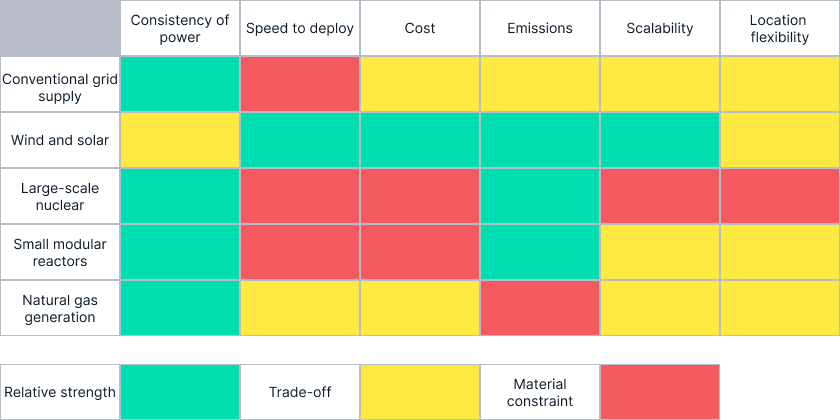
Gigawatts (GW) and megawatts (MW) measure how much electricity can be generated or consumed at a given moment. One GW equals 1,000 MW. 1 GW of continuous power could meet the electricity needs of around 870,000 homes, although this varies depending on demand and how consistently the source generates electricity.
Conventional grid supply
The electricity grid will remain the main source of power for most data centres. It gives operators access to a mix of energy sources without requiring technology companies to build and run their own power stations. It also helps balance short-term changes in electricity supply and demand.
But securing enough grid power is becoming more difficult.
Large data centres can face lengthy connection queues, and new transmission lines, substations and transformers may be needed before they can open. The availability and carbon intensity of grid electricity also vary considerably between locations.
This means that local grid capacity could increasingly influence where data centres are built and how quickly they become operational.
Amazon Web Services plans to invest $35bn in additional data-centre campuses in Virginia by 2040. The sites will depend substantially on Dominion Energy’s grid. About 25 GW of new data-centre demand already has connection dates through to 2031, ande a further 45 GW is still waiting for dates.
Wind and solar
Wind and solar power produce electricity with low operational emissions and can generally be developed more quickly than nuclear or large gas plants. Offshore wind, however, has longer development timelines and, in the US, faces significant regulatory and policy uncertainty.
Big Tech companies often secure this electricity through long-term power purchase agreements, known as PPAs. These contracts can provide greater certainty over electricity prices while giving renewable-energy developers the guaranteed income needed to finance new projects.
But renewable generation varies depending on the weather and time of day. A 1 GW solar farm will, therefore, produce less electricity over a year than a 1 GW nuclear plant operating continuously. Storage, grid power or another reliable energy source is still needed when renewable output is low.
Wind and solar is currently Big Tech’s largest energy bet by contracted capacity. They’re also the main scalable option for adding lower-carbon electricity this decade. However, further growth will need to be supported by investment in grids, storage and reliable sources of power.
Amazon, Google, Meta and Microsoft accounted for around half of global clean-energy PPAs last year. Meta and Amazon led the way, buying enough clean power to power Denmark.
Meta bought the most clean energy PPAs last year. Through its clean energy investments during the last decade, it has added nearly 28 GW of new energy to the grid across 27 US states.
Large-scale nuclear
Large-scale nuclear plants can provide reliable, round-the-clock electricity with low operational emissions. Extending the life of an operating plant or restarting a retired reactor could also be quicker and less risky than constructing an entirely new nuclear facility.
However, the number of suitable plants and locations is limited.
Restarting a reactor is still expensive and technically complex, while projects must pass extensive regulatory and safety assessments. Nuclear waste and local acceptance also need to be managed.
Large-scale nuclear could, therefore, be an attractive option where suitable plants already exist close to major data-centre hubs. But limited availability and long development times make it difficult to expand quickly across multiple locations.
Microsoft, Google, Amazon and Meta have signed at least one nuclear deal this year, committing to more than a dozen agreements worth nearly 10 GW of capacity.
Microsoft has signed a 20-year PPA supporting Constellation Energy’s restart of Three Mile Island Unit 1. Constellation owns and is restarting the reactor, while Microsoft’s commitment provides a long-term customer for the electricity it’s expected to generate. Three Mile Island Unit 2 reactor famously had a partial meltdown in the 1970s due to a cooling malfunction.
In Finland, Google has signed a 22-year contract to buy half the electricity produced by one nuclear power plant to support three new data centres, as part of a record €13bn investment.
Small modular reactors
Small modular reactors (SMRs) are designed to provide reliable, low-carbon power using smaller units that are quicker to construct than larger plants. In principle, they could be constructed closer to data-centre demand and added in stages.
Yet no commercial SMR fleet is yet operating at the scale Big Tech needs.
Costs, construction times, regulatory approval and the benefits of factory production remain unproven. Current investment is mainly funding technology development, licensing and early project work rather than operating capacity.
SMRs could be considered a potentially important source of lower-carbon power in the 2030s, but unlikely to solve the immediate shortage.
Amazon has backed nuclear start-up X-energy in a $700mn funding round with proceeds aimed at helping the company expand its supply chain and commercial pipeline, as it scales up to deploy advanced small modular reactors.
Google has agreed to purchase up to 500 MW of power from six to seven SMRs developed by Kairos Power, with the first targeted for 2030.
Natural gas generation
Fossil fuels provide electricity when required, regardless of the weather. Building dedicated generation alongside a data centre can give the operator greater certainty over future supply and reduce its dependence on a constrained public-grid connection.
Large gas plants can take several years to develop and may take longer than the data centre itself. Projects depend on obtaining turbines, permits and sufficient pipeline capacity. Once operational, they produce significant emissions and create exposure to gas prices and possible future climate regulation.
Natural gas can be a source of dedicated power for large campuses, particularly where companies do not want to wait for grid upgrades. However, gas is not necessarily a quick solution, and greater reliance on it could make Big Tech’s climate commitments harder and more expensive to meet.
A Chevron subsidiary is developing a 2.67 GW gas plant for a Microsoft-operated data centre in West Texas – currently the largest co-located natural gas power and data centre development in the US. Microsoft has agreed to purchase power through a 20-year PPA.
Also in Texas, Amazon has acquired the site for a data-centre campus expected to purchase electricity from an on-site gas project with proposed capacity of up to 7.65 GW. Some claim this could become the largest single source of climate pollution in the U.S.
Good Money Week
This week is Good Money Week, a national campaign that aims to raise awareness of responsible investing. We think that it's a great opportunity to consider both the risks and opportunities within your investments.
If you're invested in technology companies, it's worth understanding how their risk profiles are evolving. The rapid growth of AI is increasing demand for energy, creating new dependencies on power infrastructure and raising questions around future emissions.
As we explored in our recent article on water use and AI, resource availability is becoming an increasingly important factor in assessing the long-term sustainability of business growth.
If you want to learn more about investing responsibly, explore our Responsible Investment hub.