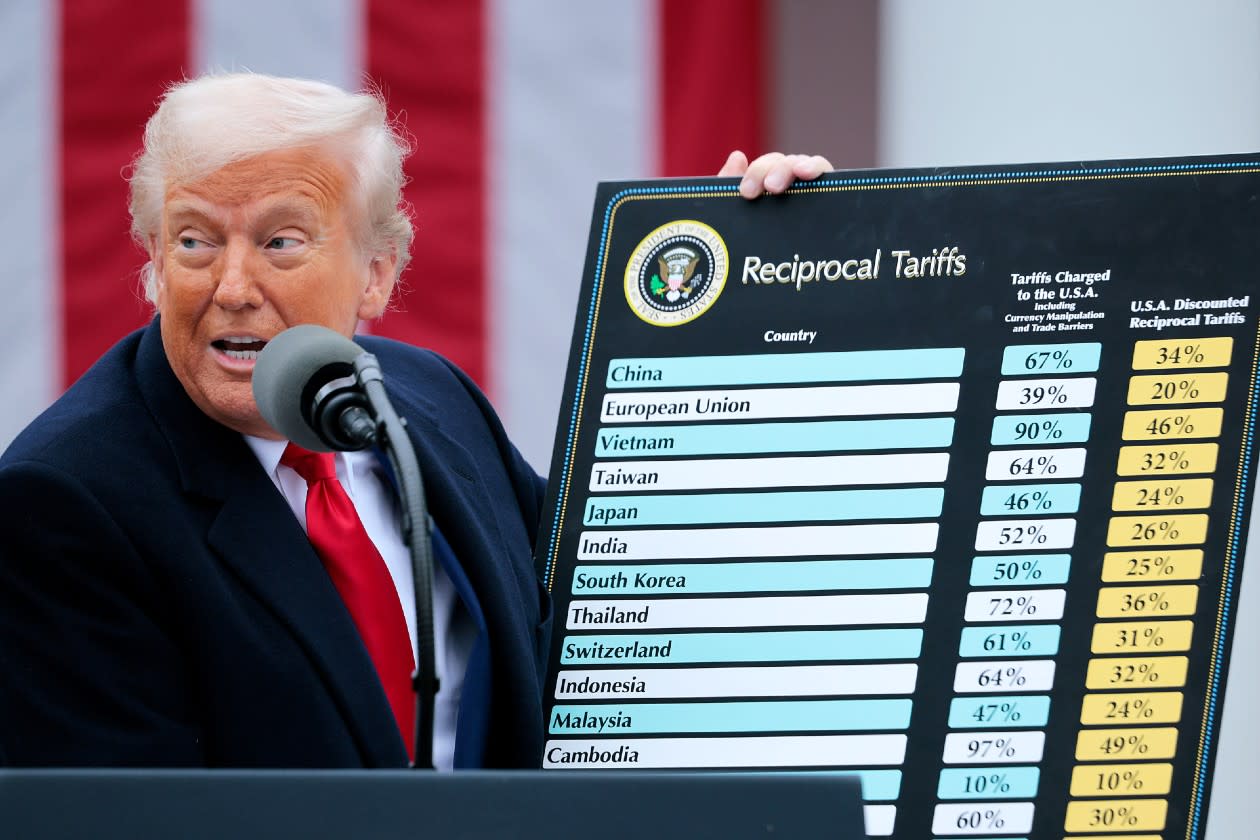


Trump made tariffs a staple in his re-election campaign. The promise? That imposing tariffs on other countries would boost US domestic production and create more jobs. But it was the scale of those tariffs that caught many investors off guard.
In April 2025, on what he dubbed ‘Liberation Day’, Trump implemented a two-tier tariff structure. A baseline 10% tariff applied to all imports and a second tier of country-specific tariffs where Trump believed the US had been victims of unfair trading practices.
So, what happened after, and what did it do to global markets?
This article isn’t personal advice. All investments fall as well as rise in value, so you could get back less than you invest. Past performance isn’t a guide to the future. If you’re not sure what’s right for you, ask for financial advice.
What happened in April 2025?
Some countries like China immediately retaliated, leading to a tit-for-tat trade war. Tariffs peaked at 145% on Chinese goods entering the US and a 125% tariff on US goods entering China.
The uncertainty this caused resulted in a shock to the market. The US stock market fell about 12% in just four days as investors grew concerned of a rise in inflation and the potential for a global recession.
This ultimately led to Trump pausing the additional tariffs, leaving just the baseline tariffs in place until August 2025, giving countries a chance to negotiate new trade deals. Trump’s back and forth birthed the name TACO trade, or Trump Always Chickens Out.
Where are tariffs now?
This is where it gets a little complicated.
Despite Trump reimplementing additional tariffs on countries that failed to negotiate trade deals in time, the current tariff rate on all US trading partners is only 10%. All because of the US Supreme Court.
The Court ruled that in using the International Emergency Economic Powers Act (IEEPA) Trump had exceeded his authority making the tariffs illegal. This also means that the US government will need to refund roughly $166bn in collected revenue from the companies who paid these tariffs.
Although his use of the IEEPA was deemed illegal, Trump still has other levers for implementing tariffs. In February 2026, utilising the Trade Act of 1974 – where he can implement up to 15% tariffs – he set tariffs at 10%. However, these tariffs can only last 150 days before having to be agreed by Congress and they’re set to expire on 24 July 2026.
If Congress does let them expire, Trump can immediately use the Tariff Act of 1930 to impose fresh tariffs. Any other measure will require an investigation which could be shut down.
Trump does have the power to target specific industries though. He’s recently announced a 100% tariff on certain pharmaceutical imports unless the manufacturer agrees to lower prices and move manufacturing to the US.
How have global markets performed throughout this period?
Global markets have generally risen even despite Trump’s tariff policy leading to lots of market volatility. Over the 12 months to the end of March 2026, the global benchmark has risen 17.97%*.
However, it has been a bumpy journey for investors. Immediately after Liberation Day markets fell significantly as they tried to understand the potential impact. The US and Chinese stock markets faced the brunt of this fall as they were likely to feel the biggest impact of the tariffs, but Europe and UK suffered too.
But as Trump began rolling back tariffs for negotiations, the markets quickly rebounded. Investors started to believe in the ‘TACO’ trade and Trump’s erratic trade policies would ultimately have little impact.
The markets continued their rally as many of the concerns failed to materialise. Concerns of a global recession and increased inflation were not playing out. US GDP grew by 2% in 2025, China’s grew 4.8% and Europe’s 1.4%, while inflation did not spike.
This has meant that even as the IEEPA tariffs were ruled illegal, markets didn’t really react to the news of replacement tariffs. Despite all the uncertainty from Trump’s trade policies global markets have generally continued to perform well even with the headwinds.
Markets have had a more difficult time recently however, this hasn’t been down to trade policies and tariffs. The markets have fallen in March after the US war with Iran started a Middle East crisis, which led to a sharp rise in oil prices.


Investors are concerned that the longer the war goes on, the more impact it will have on global economies, especially since consumers will not only be paying higher prices at the pumps, but also paying higher prices for goods.
31/03/2021 To 31/03/2022 | 31/03/2022 To 31/03/2023 | 31/03/2023 To 31/03/2024 | 31/03/2024 To 31/03/2025 | 31/03/2025 To 31/03/2026 | |
|---|---|---|---|---|---|
MSCI AC World | 12.89% | -0.93% | 21.18% | 5.33% | 17.97% |
MSCI China | -29.24% | 1.62% | -18.66% | 37.79% | 1.82% |
MSCI Europe ex UK | 6.26% | 9.54% | 13.57% | 3.34% | 15.69% |
MSCI North America | 19.91% | -2.73% | 26.85% | 5.93% | 16.05% |
MSCI United Kingdom | 19.10% | 5.60% | 8.53% | 11.99% | 23.00% |