
For much of the past few years, the big US tech companies have dominated both headlines and market growth. But as the ‘Magnificent 7’ show signs of wobbling under the weight of huge investments in artificial intelligence (AI), should investors be looking east, rather than west, for opportunities?
This article isn’t personal advice. If you’re not sure an investment is right for you, ask for financial advice. All investments and any income from them can rise and fall in value, so you could get back less than you invest. Past performance isn’t a guide to the future.
Asia’s ‘Fab 5’
Stock market performance in Asia has improved recently. Having underperformed broader global markets for a number of years, growth in technology companies are playing a leading role in a reversal of fortunes.
Just as the ‘Magnificent 7’ have led the US market, Asia has its own group of tech heavyweights. Taiwanese giant TSMC, along with China’s Tencent and Alibaba, and Samsung Electronics and SK Hynix in Korea, are the five largest companies in the MSCI AC Asia Pacific ex Japan index. Together they account for nearly 30% of a benchmark that spans India, China, Singapore, and more. In 2025, these companies contributed 40% of the benchmark’s growth.
The AI supply chain
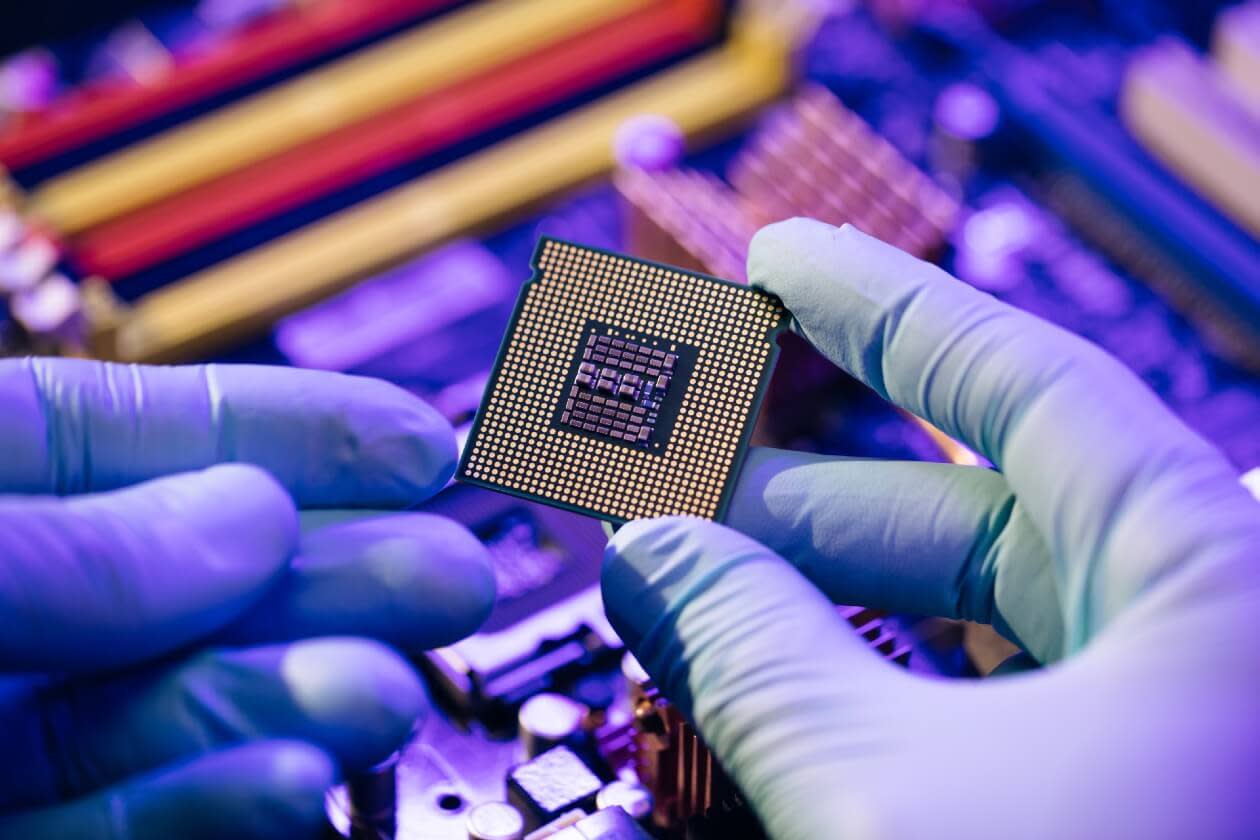
Three of the ‘Fab 5’, TSMC, Samsung, and SK Hynix, have established dominant positions in global AI supply chains.
TSMC manufactures most of the advanced chips designed by Nvidia to power AI tools, while also supplying Broadcom, Apple, and many other chip designers. The company’s position with AI supply chains is so entrenched that Jensen Huang, founder of Nvidia, was quoted as saying “without TSMC, there be would no Nvidia”. Consistent share price growth in recent years has made TSMC one of the largest companies in the world by market capitalisation.


In Korea, Samsung and SK Hynix are market leaders in high bandwidth memory (HBM). Their products allow for faster data processing, which is crucial for AI models to access the data they require in a timely manner. While SK Hynix is at the forefront of this technology, Samsung is rapidly catching up.
Large increases in revenue expectations for both companies, the two largest in Korea, led to rapid share price appreciation. This was a key driver behind the MSCI Korea benchmark returning a staggering 177.24%* in the 12 months to the end of February 2026.
Annual percentage growth
Feb 2021 – Feb 2022 | Feb 2022 – Feb 2023 | Feb 2023 – Feb 2024 | Feb 2024 – Feb 2025 | Feb 2025 – Feb 2026 | |
|---|---|---|---|---|---|
MSCI AC Asia Pacific ex Japan | -8.24% | -2.08% | 1.26% | 13.47% | 37.53% |
MSCI AC Asia Pacific ex Japan/Information Technology | -2.01% | -10.91% | 17.99% | 19.15% | 94.80% |
MSCI Korea | -14.44% | -9.10% | 9.42% | -15.24% | 177.24% |
What about China?
One country that finds itself on the fringes of supply chains is China. While many of its geographical neighbours have established a foothold in the global AI market, China has largely been left to go it alone.
Successive US presidents have imposed restrictions on China’s ability to import high-end equipment needed to design and manufacture chips, citing national security concerns. Conditions have since softened, but the country has plenty of catching up to do. That said, China still has AI opportunities to offer.
Despite lacking access to the latest technology, companies in China have set about developing low-cost AI models.
In 2025, the launch of DeepSeek’s model shook financial markets as it threatened to offer the same level of processing as leading US-developed models, but at a much cheaper cost. Since then, Alibaba, a company known for its e-commerce platform, has continued to release upgrades to its in-house AI model.
The latest version boasts improvements to both processing and cost compared to its predecessor. As with many industries in China, there’s fierce competition between competitors looking to take the lion’s share of the market. DeepSeek is rumoured to be releasing its next iteration soon.


Is there more to come?
With leading companies seeing such strong growth over the past year, it’s only fair to wonder if this can continue. There aren’t yet clear signs that capital expenditure from the US will decrease, although the growth rate may be slowing.
While sentiment is important, at some point companies will need to show that AI can be monetised if they want to maintain investment. This is important to companies in the ‘Fab 5’, which occupy the beginning of the supply chain.
Recent conversations with Asia fund managers represented on the Wealth Shortlist were positive on the future of technology in the region, with the ‘Fab 5’ forming key parts of a number of funds.
However, current events in the Middle East provide a timely reminder of the risks of investing in some of these countries. China and South Korea are two of the largest importers of oil passing through the Hormuz Strait, which right now is effectively closed to shipping. Not only does a rising oil price provide problems for countries that import most of their energy, but there’s also the risk that, without alternatives, supply may begin to dry up.
2 fund ideas for exposure to Asian technology companies
Investing in these funds isn't right for everyone. Investors should only invest if the fund's objectives are aligned with their own, and there's a specific need for the type of investment being made. Investors should understand the specific risks of a fund before they invest and make sure any new investment forms part of a long-term diversified portfolio.
Remember, all investments can fall as well as rise in value, so you could get back less than you invest. For more details on each fund, its charges, and specific risks, see the links to their factsheets and key investor information.
Jupiter Asian Income
The Jupiter Asian Income fund aims to deliver income and capital growth over the long term by investing in companies across the Asia Pacific region, excluding Japan. The fund focuses on larger businesses in developed markets, like Australia and Singapore, as well as in higher risk emerging markets like Taiwan.
Jason Pidcock has managed the fund since it launched in 2016. He’s an experienced Asian fund manager and one we hold in high regard. Currently around a third of the fund invests in technology companies, with large investments in businesses in South Korea and Taiwan.
The fund invests in 25-30 companies, which is a higher risk approach as it means each one can have a significant impact on performance. Investors should be aware that charges are taken from capital, which can increase the yield but reduces the potential for capital growth.
Annual percentage growth
Feb 2021 – Feb 2022 | Feb 2022 – Feb 2023 | Feb 2023 – Feb 2024 | Feb 2024 – Feb 2025 | Feb 2025 – Feb 2026 | |
|---|---|---|---|---|---|
Jupiter Asian Income | 7.82% | 6.75% | 6.21% | 9.45% | 44.49% |
IA Asia Pacific ex Japan | -6.44% | -1.66% | -1.79% | 10.24% | 36.48% |
iShares Pacific ex Japan Equity Index
The iShares Pacific ex Japan Equity Index fund provides low-cost diverse exposure to countries like Taiwan, South Korea, and Australia.
The fund aims to track its benchmark, the FTSE World Asia Pacific ex-Japan Index, by investing in every company in the index and in the same proportion, rather than trying to perform better than it. The fund includes investments in higher-risk emerging markets. The fund can also use securities lending, which adds risk.
An index tracker fund is one of the simplest ways to invest. This fund could be a great, low-cost starting point to add diversification to a global investment portfolio aiming for long-term growth.
Annual percentage growth
Feb 2021 – Feb 2022 | Feb 2022 – Feb 2023 | Feb 2023 – Feb 2024 | Feb 2024 – Feb 2025 | Feb 2025 – Feb 2026 | |
|---|---|---|---|---|---|
iShares Pacific ex Japan Equity Index | 1.97% | 0.51% | 4.30% | 7.44% | 63.46% |