

TSMC’s first-quarter revenue rose by 35% when ignoring currency moves, to $35.9bn ($35.2bn expected). Growth was supported by strong demand for leading-edge technologies, particularly in high-performance computing (AI).
Operating profit increased 62% to $20.9bn, helped by operating expenses growing at a slower pace than revenue and improved gross margins.
Free cash flow was $11.1bn, and net cash stood at $73.8bn at the end of the period.
Second-quarter revenue is expected to land between $39.0-40.2bn ($37.8bn expected).
Currency = US dollar.
The shares were up 1% in pre-market trading.
Our view
TSMC delivered another record quarter and maintained a strong outlook. AI demand is not slowing, and management is extremely confident that this is a sustainable trend. This is typically a cautious business; investment is carefully considered, but with supply so tight, it's pulling forward factory openings in Taiwan, Japan and the US, whilst raising the investment budget.
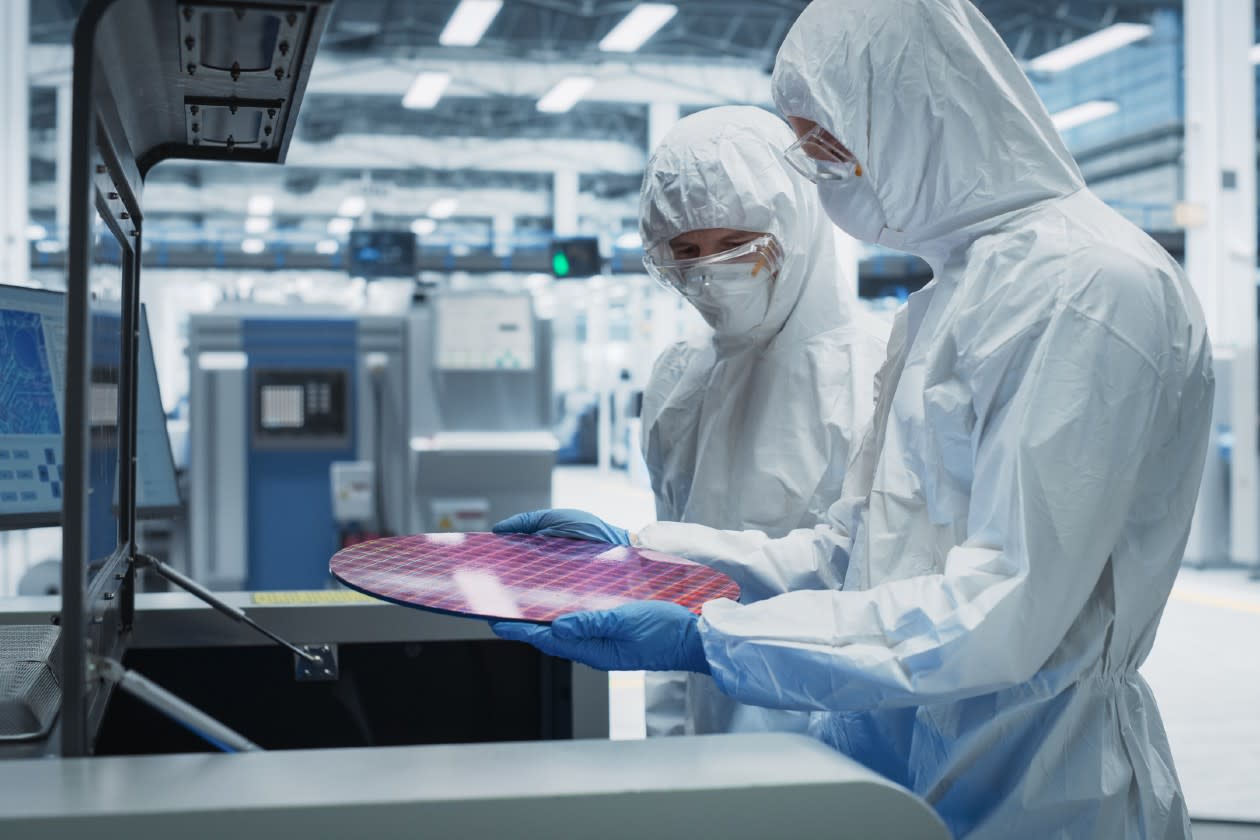
TSMC is the world’s leading semiconductor manufacturer, producing and assembling chips for clients like NVIDIA, ARM, and Apple rather than designing its own. Microchips are among the most complex devices ever created, and they continue to grow more intricate. As mentioned, TSMC is typically cautious on capacity given the industry’s boom-and-bust cycles, so this aggressive timeline helps underpin our thesis that the AI infrastructure buildout is still early.
TSMC’s dominance rests on technology leadership and manufacturing excellence. Its Taiwan plants are the gold standard, but expansion into the US and Japan aims to diversify supply. Costs are higher abroad, and margins will face pressure as new sites ramp up, yet TSMC has managed this well so far, and margins remain strong.
Competition is intensifying, pushing TSMC to accelerate its pursuit of cutting-edge technology. US sites once lagged a generation behind Taiwan, but that’s changing as rivals like Intel chase the bleeding edge with government backing. We believe TSMC remains the clear leader, and these faster expansion plans should help preserve its dominant position.
Tariffs haven’t had any major impact on performance; the key shift is an increased pledge to build sites in the US. As mentioned earlier, these are lower-margin; however, the US accounts for around 75% of revenue, so there’s also some logic to building where the demand is.
Tensions between Taiwan and China are an ever-present threat, and one that’s hard to quantify. This remains an ongoing risk factor that is difficult to quantify. There’s also the potential impact of higher costs from the Middle East conflict, but nothing that management has given any firm guidance on yet.
Capex spend is typically an indicator of future revenue potential, so we take the upped investment guide and strong customer demand signals as good indicators for the coming years. Plus, TSMC’s investment plans are well supported by a strong balance sheet and impressive cash flows.
TSMC sits at the heart of what we believe is an AI-driven semiconductor buildout that remains in its early stages, with scope for revenue and profit to outpace current expectations over time. However, valuation levels, as reflected in the price-to-earnings ratio, are near historical peaks, suggesting that much of the optimism is already priced in.
Environmental, social and governance (ESG) risk
The semiconductor sector is medium-risk in terms of ESG. Overall, this risk is managed adequately in Europe and North America but has considerable room for improvement in the Asia-Pacific region. Its reliance on highly-specialised workers means labour relations is one of the key risk drivers. Other risks worth monitoring include resource use, business ethics, product governance, and carbon emissions.
According to Sustainalytics, TSMC’s management of material ESG issues is strong.
TSMC has a company-wide target to reach net zero by 2050, and plans to use 40% renewable energy for all fab operation sites by 2030. Its latest products promise to deliver substantial energy efficiencies for end users. TSMC incorporates water scarcity and flooding into its enterprise risk management, but its water intensity is well above the industry median, suggesting there is room for improvement. Skill shortages are an industry-wide issue, but TSMC has a strong commitment to talent development and staff retention has been moving in the right direction.
TSMC key facts
All ratios are sourced from LSEG Datastream, based on previous day’s closing values. Please remember yields are variable and not a reliable indicator of future income. Keep in mind key figures shouldn’t be looked at on their own – it’s important to understand the big picture.
This article is original Hargreaves Lansdown content, published by Hargreaves Lansdown. It was correct as at the date of publication, and our views may have changed since then. Unless otherwise stated estimates, including prospective yields, are a consensus of analyst forecasts provided by LSEG. These estimates are not a reliable indicator of future performance. Yields are variable and not guaranteed. Investments rise and fall in value so investors could make a loss.
This article is not advice or a recommendation to buy, sell or hold any investment. No view is given on the present or future value or price of any investment, and investors should form their own view on any proposed investment.