


There's a new occupant in Number 10, and a new Number 10 coming to the North.
New governments bring new priorities, and over the next few weeks and months, Andy Burnham and the newly appointed Chancellor, John Healey, will be looking to get ready for their first Budget.
The immediate not-knowing can be uncomfortable and trying to speculate on Budget announcements tempting. But if there's one lesson for moments like these, it’s that markets have seen it all before and your long-term plan rarely needs to change as quickly as the headlines do.
The things that make the biggest difference to your money over time are also the things most firmly in your control. Stay invested, stay diversified, and make the most of the tax allowances available to you.
Andy Burnham is the 11th prime minister since HL was founded in 1981 and Healey the 16th Chancellor. And we’ve helped Britain invest through it all. In this deep dive our experts share their analysis, tips and investment picks to help you make the most of your money through this new premiership and beyond.
This article is for information only and not personal financial advice. Investing can help your money grow, but the value of investments can rise and fall, so you could get back less than you put in. Investing is for the long term, typically 5 years or more.
If you’re not sure investing is right for you, a financial adviser can help.
What does it mean for your money?
What could a Burnham government mean for your money?
Helen Morrissey, Head of Retirement Analysis
As the UK welcomes its fifth prime minister in as many years speculation has already begun on what tax changes Andy Burnham might make. Rumours are wide ranging, covering everything from income to capital gains tax (CGT) but it’s important not to make snap decisions based on what you think might happen. You may come to regret it later.
We’ve been here before.
In the run up to the last Budget, rumours that the government would reduce the amount of money people could take tax free from their pensions prompted people to take it while they still could. In the end the announcement didn’t happen, and it left a lot of people with a chunk of money they never intended to take and no idea what to do with it.
None of us has a crystal ball and we don’t know what’s around the corner but it’s better to work within the system that’s currently in place when making personal finance decisions rather than trying to pre-empt what you think may happen.
Making the most of your allowances
Cash ISA
Big changes are coming for ISAs in 2027. The £20,000 annual limit remains in place but from April people aged under 65 will only be able to allocate £12,000 of that to Cash ISAs. This limit will cease to apply in the tax year you turn 65. So, if you’re over 65 you can continue to contribute up to £20,000 to your Cash ISA.
This is all part of the government’s plan to boost investment with people encouraged to put any left-over allowance into stocks and shares.
Whether we see an increase in investing as a result of the change remains to be seen but those aged under the age of 65 who want to commit their entire £20,000 to Cash ISAs have until 5 April 2027 to do so. It’s also worth noting that for under 65’s, you will no longer be able to transfer non-Cash ISAs to a Cash ISA from next tax year.
Stocks and Shares ISA
From 6 April 2027 any interest paid on cash held in a Stocks and Shares ISA will be subject to 22% tax. This is to deter people from trying to get around the new Cash ISA restrictions by putting cash into their Stocks and Shares ISA instead.
So-called “cash-like” investments – namely Money Market Funds, will still be allowed as long as they don’t make up the whole portfolio.
This does add complexity to a product loved for its simplicity and it’s important not to let the changes catch you unawares, landing you an unexpected tax charge.
But it’s worth saying that ISAs are still a hugely tax-efficient way to build future wealth, with your investments sheltered from capital gains and UK dividend tax that they may be subjected to if they weren’t in the ISA wrapper.
Salary sacrifice
From April 2029 National Insurance relief on pension contributions made via salary sacrifice will be restricted to the first £2,000. After this, both employers and employees will pay National Insurance.
However, there’s still time to make the most of the current system before the changes come in. Even after the change, your pension will still be a hugely efficient way to save for retirement. That’s because contributions attract tax relief and if employed you normally get an employer contribution. Money in a pension is for your retirement, so you can’t usually access your money before age 55 (57 from 2028).
Inheritance tax
Another major incoming change from April 2027 is that most unused pensions and pension death benefits become part of your estate for inheritance tax (IHT) purposes.
This is a marked departure from the previous position where most pensions could be passed on free of IHT. If death occurs before age 75 then it can often be passed on free of income tax too. This led to many people spending down other assets and leaving their pensions untouched to pass down the generations.
The upcoming change means people are rethinking their plans and consider gifting to loved ones while they are still alive so they can reduce the value of their estate. This has the benefit of not only potentially saving your family an IHT bill, it also enables you to see the benefit of your gifting.
Contributing to a Junior SIPP or Junior ISA can also helped a young loved one get a real head start in their investing journey.
Gifts of any size can be made to another individual, and they pass out of your estate for IHT purposes after seven years – these are known as potentially exempt transfers.
There are also an array of allowances that you can use where the gift leaves your estate for IHT purposes immediately. These include the £3,000 annual exemption, £250 small gift allowance as well as gifts for when loved ones get married.
Another popular approach is the gifting out of surplus income rules whereby a gift of any size can be given, and it leaves your estate immediately provided that it comes from income rather than capital, is given regularly and does not impact your standard of living.
These rules are extremely useful but can be complex.
Detailed notes need to be made around gift giving so that your family has evidence if needed. It can be a good idea to take financial advice if you’re considering a gifting strategy to make sure you do not inadvertently breach any rules.
It’s also vitally important that you take a long-term view. You don’t know how long you’re going to live, and you do not want to leave yourself short of money later. Again, a financial adviser can help plan your income and gifting strategies so that you continue to live well in retirement while also helping loved ones.
Venture Capital Trusts (VCTs)
If you have used all your ISA and pension allowances, you may wish to consider VCTs as part of your financial planning.
VCTs are listed on the London stock market and raise money from investors to help young, unlisted companies grow. There are generous tax incentives to invest in VCTs – you can invest up to £200,000 per tax year and claim up to 20% income tax relief. There’s also no capital gains or dividend tax to pay.
However, it’s worth saying that they’re higher risk and the rules are complex. The income tax relief is also only available on new shares and must be held for at least 5 years.
They should only be used by experienced investors and form part of a well-diversified portfolio. Speaking to a financial adviser is a good way of ensuring that this is the right approach for you.
What does it mean for your money?
What does it mean for UK stock markets?
What could a Burnham government mean for UK stock markets?
Nicholas Hyett, Lead Alternative Analyst
For ten years the UK has bounced from political crisis to political crisis. We’ve had the same number of Prime Ministers in 10 years as in all of 1974 to 2016, and it’s become common practice for newspapers to suggest the UK is “ungovernable”.
You’d be forgiven for thinking the UK stock market has therefore performed poorly.

Except it hasn’t. The current period of political instability is often dated to the Brexit referendum in June 2016. Since then, the FTSE 100, which reflects the performance of the 100 largest companies on the UK stock market, has returned 146.6%. The FTSE 250, which represents mid-sized UK companies has made 78.5% (Source: Lipper IM run to 30 June 2026). That might be some way behind the global stock market – but it’s hardly a terrible return.
In fact, look back at the performance of the UK stock market over the last 40 years or so and the political ups and downs of the last decade don’t stand out. Politics is noisy at the time, but its long-term impact on markets is not obvious.
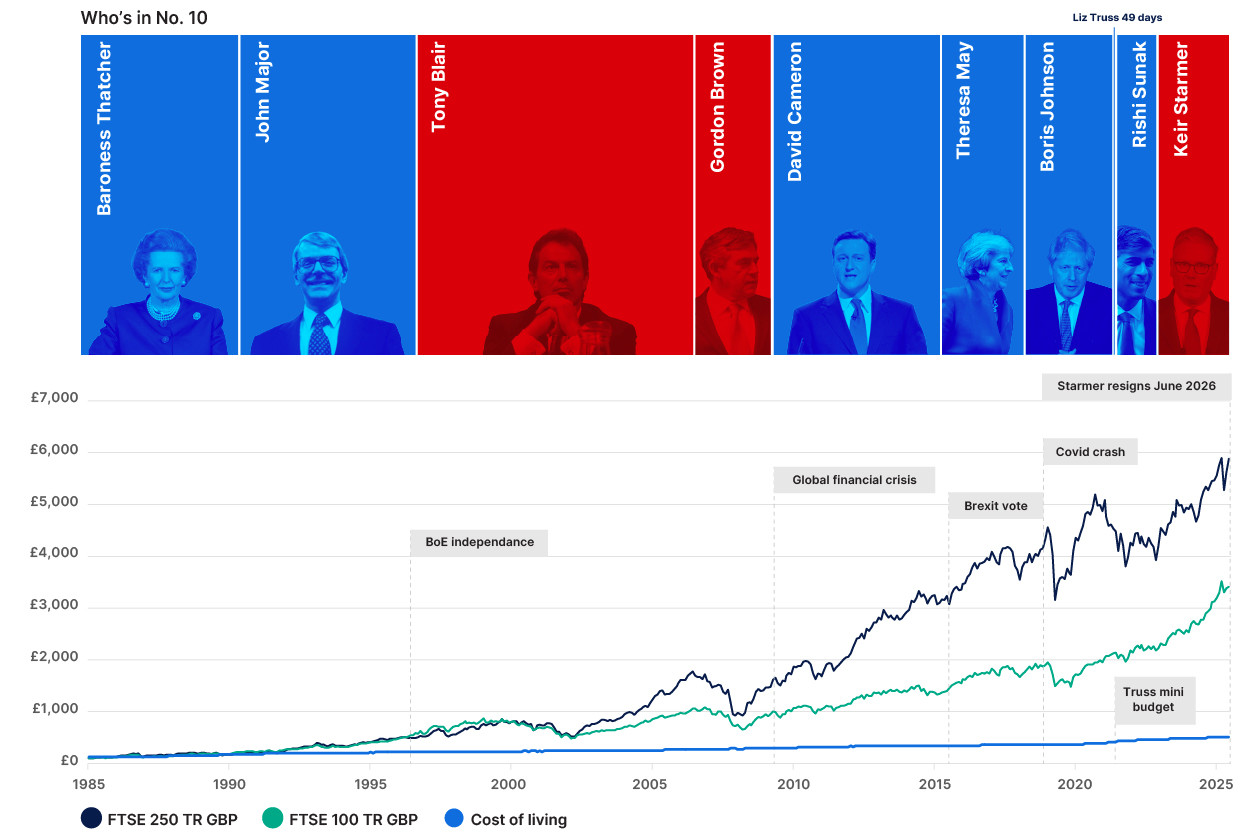
Are UK shares undervalued?
Still, at first glance the UK stock market is cheap, superficially at least. It has traded on lower valuations than the US for a decade. In fact, the gap between the average price to earnings ratio (P/E ratio) of the largest UK companies and the largest US companies has been steadily widening.
There’s more than one explanation for that.


For starters the UK market is dramatically underweight the kinds of fast-growing tech companies that command premium valuations. The FTSE 100 is 2.3% tech versus 38.0% for the US market (and that’s before you include companies like Amazon, Alphabet and Meta which do not technically sit in the tech sector).
But even allowing for the differences in sectors, some investors argue UK companies are cheaper than they should be. The recent flurry of merger and acquisitions backs that up – as international buyers swoop in to buy UK companies.
It’s possible the UK’s political instability is playing a part – making investors think twice before buying UK assets. If Andy Burnham can set things on an even keel that attitude could change, possibly leading to a recovery in UK valuations and rising share prices as a result.
That could be a good reason for upping your exposure to UK assets, especially if you happen to have a particularly favourable view of the incoming administration.
The risk of investing on political predictions
A word of warning here though. Guessing political outcomes is not easy and assessing the second order effects of those outcomes is even more difficult.
Think back to Brexit.
Many investors were nervous about the possibility of the UK leaving the EU and given that backdrop you’d expect leaving to see UK share prices fall. In the event the fall in sterling meant the value of the FTSE 100’s overseas earnings spiked and the index finished 2016 nearly 20% above where it started.
Try and daisy-chain political events into investment decisions and there’s a real chance you get burned.
That’s not to say you shouldn’t take politics into account when building a portfolio. But it does mean making big one-way bets is higher risk. Instead, we think investors should seek diversification, with some investments in a position to capitalise on events regardless of what happens.
What does it mean for your money?
What does it mean for UK stock markets?
What does it mean for gilts?
What could a Burnham government mean for gilts?
Hal Cook, Senior Investment Analyst
One corner of markets where politics matters a lot is the UK government debt (or gilt) market.
Andy Burnham’s potential impact is hard to predict. However, most changes in Prime Minister don’t have an immediate and lasting impact on government debt markets. The exception is Liz Truss, where a rebellion in the gilt market was the key reason she only lasted 49 days in office. That will live long in the memory of politicians, and most remain cautious around policies that could cause a lot of upset to bond investors.
Gilt yields remain high, with the 10-year yield around 4.7-5% since the beginning of the Iran war. For investors, locking in this level of return over the next few years by investing in gilts directly could be appealing.
But for Andy Burnham it represents a challenge to his ability to increase overall levels of government spending. This is because gilt yields reflect how much it costs the government to borrow money.
The Debt Management Office announced in March they expected to issue £252bn of gilts over the 2026/27 tax year. A 1% change in gilt yields means an approximate £2.5bn change in annual interest payments on this tax year’s government borrowing. Burnham will therefore be keen to keep gilt yields in check.
Whether the yields on gilts are truly attractive as an investment largely depends on what other developed market government bonds are yielding too – 10-year US Treasuries have been yielding between 4.25-4.65% since April for example.
Because of the large number of options available, we think the best way to invest in bonds is through a fund that can take advantage of different opportunities across the world as they become available. This has the benefit of reducing political or policy risk from any individual country.
How to position your portfolio amid political change
Investing in funds
Hal Cook, Senior Investment Analyst
Nicholas Hyett, Lead Alternatives Analyst
Investing in these funds is not right for everyone. Investors should invest only if the fund's objectives are aligned with their own and there's a specific need for the type of investment being made. Investors should understand the specific risks of a fund before they invest and make sure that any new investment forms part of a long-term diversified portfolio.
For more details on each fund’s objectives, its charges, and specific risks, see their factsheets and key investor information. As always, yields and income are not guaranteed and will change over time.
Invesco Tactical Bond
Invesco Tactical Bond managers Stuart Edwards and Julien Eberhardt can invest in all types of bonds, with few constraints. This includes high yield and emerging market bonds, as well as derivatives. All of which can add risk if used. However, the flexibility means they’re able to invest in the areas of global bond markets that they think offer the best value.
They tend to invest more prudently than some other bond managers, meaning they usually have at least some investments in developed market government bonds, like gilts. At the end of June 2026, they had around 45% of the fund invested in government bonds, with 15% invested in gilts.
We think this is a good fund for exposure to the wider bond market. It takes away the hassle of deciding which type of bonds to invest in, and when, because the managers are given the discretion to make these decisions.
Artemis UK Smaller Companies
Smaller companies tend to be less global, with more exposure to the domestic economy than their peers in the FTSE 100. That can be a source of added risk, because they a more dependent on the fortunes of one country, but it could also mean they’re better placed to benefit from any Burnham bounce in the economy.
Investors who are especially value minded might want to consider Artemis UK Smaller Companies. The team look to back companies that they believe are undervalued, but with strong free cash flow and robust balance sheets. They believe this makes companies more robust through economic cycles and means they don’t have to rely on a short-term catalyst to boost performance.
The portfolio of 60-90 companies has an average P/E ratio of 10.8 – below the average for UK companies.
HL Investments
James Harrington, Product Specialist
This could be attractive for investors looking for income from UK shares without having to choose individual companies themselves.
UK businesses have a long history of paying dividends, and many remain well placed to share profits with investors over time. The funds two objectives are to provide a higher income than the wider UK stock market, while also seeking to deliver long-term growth, although of course there are no guarantees.
What makes this fund different from Artemis UK Smaller Companies is its income focus and multi-manager approach. This provides a higher level of service which does mean the cost is higher than for standard funds.
HL selects experienced external managers and gives each a clear role, so investors get access to different income-focused styles in one fund. That can help spread risk and reduce reliance on any single manager or company.
It could suit a portfolio looking for to add UK equity income. The fund invests in smaller companies, which adds risk. It also takes charges from capital, which can increase income but reduces the potential for capital growth.
For investors who want a simple way to build a wider portfolio, HL’s ready-made investments can also help. Rather than choosing lots of individual funds yourself, they offer a ready-built mix of investments in one place. That can make it easier to match your portfolio to your goals, how long you plan to invest for, and how much risk you’re comfortable taking.
The range includes different options for different types of investors. Some funds focus more on long-term growth, while others aim to balance growth with more cautious investments. There are also income-focused options for investors who want their money to work harder in a different way.
Use to start your portfolio, or as a central investment strategy around which you can build to your investment preferences, the ready-made funds can help add wider diversification across markets, regions and asset classes.
The HL fund ranges are managed by Hargreaves Lansdown Fund Managers, part of the Hargreaves Lansdown Group.
Article image credit: Nicola Tree