

Third-quarter revenue rose 41% to $46.7bn ($44.9bn expected). Growth was supported by strong demand for leading-edge technologies, particularly in high-performance computing, which accounted for 68% of revenue.
Operating profit increased 64% to $27.4bn ($26.1bn expected), helped by operating expenses growing at a slower pace than revenue. Gross margin dipped slightly from the previous quarter to 66.4% as the newer 2nm technology began ramping up.
Free cash flow more than tripled to $14.9bn, and net cash stood at $93.6bn at the end of the period.
Fourth-quarter revenue is forecast to land between $52.3-54.3bn ($49.1bn expected).
Currency = US dollar.
The US listing was down 1.6% in pre-market trading.
Our view
This was a strong quarter, but the outlook was the real story. Revenue growth for the full year is now expected to be around 44%, and management thinks its target for AI chip demand, mid-to-high 50s% annual growth out to 2029, will probably prove too low. That target doesn't even include the processors and networking chips that AI is now pulling along with it.
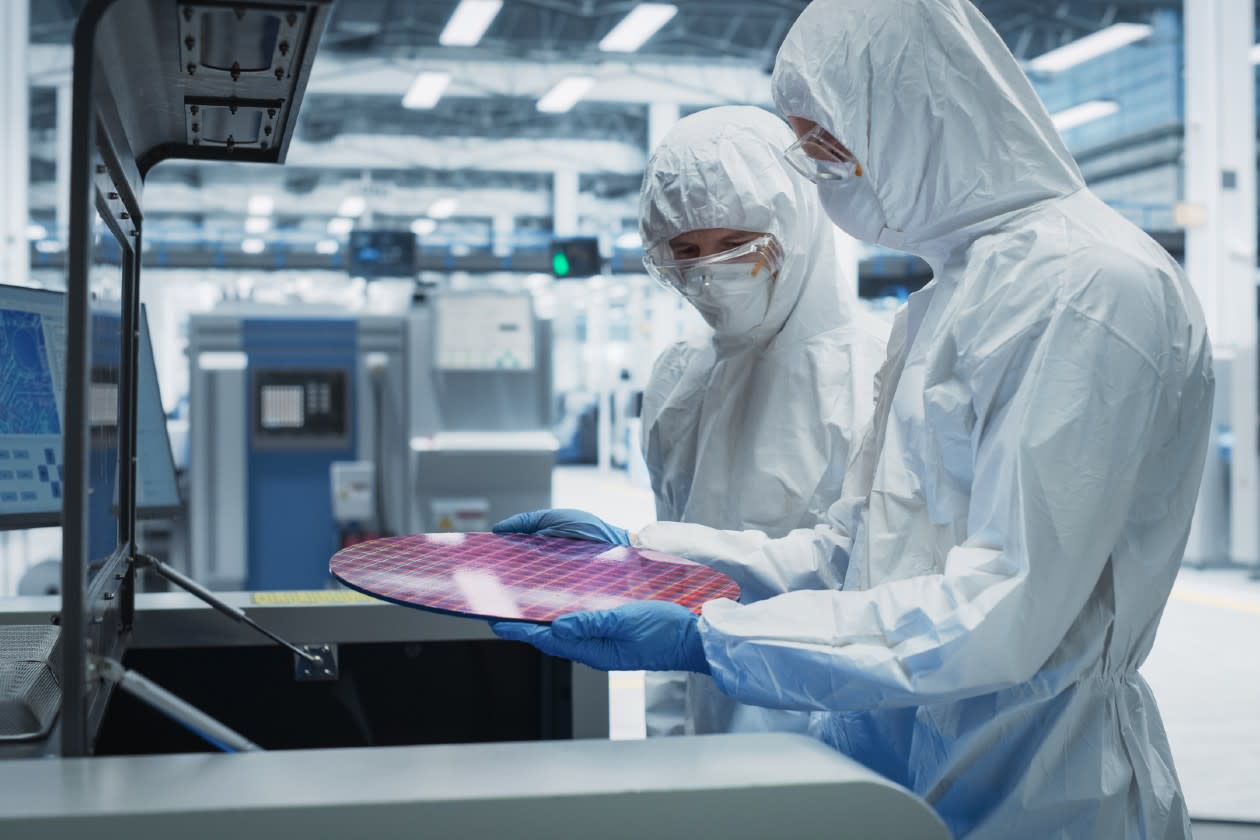
TSMC is the world's leading chipmaker, building the most advanced chips for the likes of Nvidia and Apple. Its lead comes from technology and manufacturing scale that rivals have struggled to match, and it now holds over 70% of the market for outsourced chipmaking. That puts it at the centre of almost every major AI project, whoever ends up winning the race.
What TSMC is doing tells you as much as what it's saying. Chipmaking is a boom-and-bust industry, so TSMC is usually careful about adding capacity, yet it now has around 25 new factories in the works. It's even sending its own teams to check on data centre and power buildouts in the US, which is smart diligence, and so far it hasn't seen anything to make it slow down.
That ambition comes with a hefty bill, with investment over the next three years set to be significantly higher than the last three. But with over $90bn of net cash and enormous cash flows, TSMC can fund the expansion comfortably without stretching the balance sheet. Management also expects revenue to keep growing faster than investment, which should keep returns healthy.
Margins are the area to watch. Ramping up the newest technology and running higher-cost factories overseas are both headwinds, while equipment, materials and labour are all getting more expensive. But when demand outstrips supply, TSMC has real pricing power, which should go a long way to absorbing the pressure.
New agentic tools that complete tasks rather than just answer questions, and the rise of cheaper open-source models, are two areas we see driving extra demand. TSMC wins so long as demand for AI continues, regardless of who’s providing it. That underpins our positive view on the earnings trajectory, and we see upside to current expectations.
A recent wobble in AI stocks has pulled the price-to-earnings ratio back to around 20 times. That isn't a demanding level for a business that can see this far ahead, and we see scope for this to improve. Key risks include physical and financial headwinds to the AI buildout, as well as rising costs eating into margins as expansion ramps up.
Environmental, social and governance (ESG) risk
The semiconductor sector is medium-risk in terms of ESG. Overall, this risk is managed adequately in Europe and North America but has considerable room for improvement in the Asia-Pacific region. Its reliance on highly specialised workers means that labour relations is one of the key risk drivers. Other risks worth monitoring include resource use, business ethics, product governance, and carbon emissions.
According to Sustainalytics, TSMC’s management of material ESG issues is strong.
TSMC has a company-wide target to reach net zero by 2050 and plans to use 40% renewable energy for all fab operation sites by 2030. Its latest products promise to deliver substantial energy efficiencies for end users. TSMC incorporates water scarcity and flooding into its enterprise risk management, but its water intensity is well above the industry median, suggesting that there is room for improvement. Skill shortages are an industry-wide issue, but TSMC has a strong commitment to talent development and staff retention has been moving in the right direction.
TSMC key facts
All ratios are sourced from LSEG Datastream, based on previous day’s closing values. Please remember yields are variable and not a reliable indicator of future income. Keep in mind key figures shouldn’t be looked at on their own – it’s important to understand the big picture.
This article is original Hargreaves Lansdown content, published by Hargreaves Lansdown. It was correct as at the date of publication, and our views may have changed since then. Unless otherwise stated estimates, including prospective yields, are a consensus of analyst forecasts provided by LSEG. These estimates are not a reliable indicator of future performance. Yields are variable and not guaranteed. Investments rise and fall in value so investors could make a loss.
This article is not advice or a recommendation to buy, sell or hold any investment. No view is given on the present or future value or price of any investment, and investors should form their own view on any proposed investment.